Interview with Deborah Tomkins – Aerth, a Genre-Based Novella-in-Flash

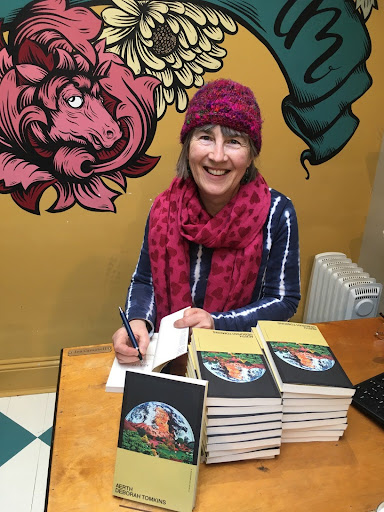
This month, novella-in-flash.com features an interview with the writer Deborah Tomkins. Deborah’s novella-in-flash Aerth was published by Weatherglass Books in January this year. It has already sold out of the first print run and has been reprinted. 

Michael: Welcome to this blog series, Deborah. It’s been so exciting to see how your novella has been well received in early reviews, including in broadsheet newspapers such as The Guardian and The Telegraph, as well as by book reviewers on Youtube and Instagram. Especially as it’s one of those rare things – a genre-based novella-in-flash (with speculative, and science-fiction, and climate fiction elements). I am very much hoping your success inspires more flash fiction writers to try writing genre-based novellas. 

I think the tale of this book’s journey to publication is worth re-telling to readers, as it strikes me – from the outside – as an inspiring story of never-give-up determination. 
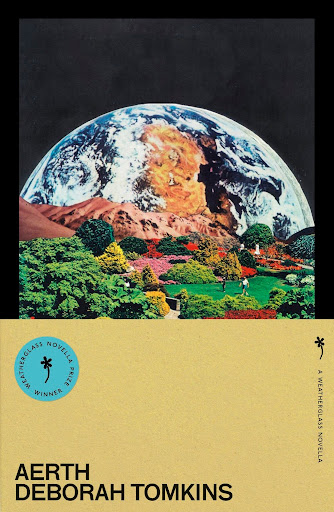
You’ve talked about how a version of this book was first longlisted in 2019 in the Bath Flash Fiction Award Novella-in-Flash competition. And you kept working on it for several years before submitting it to the Weatherglass competition. Could you talk a bit about that journey? Were there any particularly difficult moments along the way? And also what lessons you might be taking from the process, for your future writing projects?

Deborah: Thank you so much, Michael, and thank you for inviting me onto the blog series too. 

It was quite a journey. It ended up being about 5 years, from first seeing if I could write a novella-in-flash (and flash fiction itself was still very new to me back in 2018, when I began this story) to finally sending it in August 2023 to Weatherglass Books for their Inaugural Novella Competition, which was judged by Ali Smith. That last year or so I didn’t do much to it, actually; it just sat in my computer and I occasionally sent it off to a publisher or a competition. 

There were lots of difficult moments! Novellas are quite difficult, and a novella in flash is not only difficult but also very slippery, in the sense that these tiny ideas that you have may take the story in any number of directions – and they did. It’s not easy choosing what to keep and what to throw away (although I think no writing is ever wasted – you’re always learning what works and what doesn’t), or working out what direction is the most fruitful one for the story, or what will be most surprising to a reader. And as a writer I found I was too close to see that clearly, so the long process was very helpful – leaving it for several months and going back to it with fresh eyes.

I kept thinking about it, though, and even when I thought it was “finished”, I would go back to it and play around with it some more, particularly when it hadn’t been accepted somewhere. The story – and Magnus, my protagonist – wouldn’t leave me. I kept feeling that it was a deeper and stranger story than I had been allowing it to be.

I’ve also realised that I’m not a fast writer. I need to spend a lot of time with a story, to see what it might be saying or where it may want to go. 

Michael: It’s really interesting that you noticed an urge to make the story deeper and stranger. My hunch is that for so many novella-in-flash manuscripts “deeper and stranger” would be a very productive instinct to follow! And personally rewarding and fun for the writer during the process, too. 

I want to ask you next about the genre-based elements of this novella-in-flash. If we think about Aerth’s qualities as a piece of “climate fiction” first of all: you’ve been involved in writing about the environment for some time – for example via Bristol Climate Writers, and also in other contexts. I’m wondering what questions (about climate, or environment, or ecology) you particularly wanted to explore as you wrote it? And I’m also interested, with this piece of climate fiction, in how you saw the roles of the novella’s three different story-worlds (not only the twin planets of Aerth and Urth, but also Mars, which features too), which each have such different qualities as settings?

Deborah: In many ways this book came together accidentally, in that I didn’t have a plan at the start. It was very much not plotted! I wrote small pieces – or fragments of pieces – as they occurred to me, and as I was thinking about Magnus and his life. The very first piece was one I wrote in a workshop at the Flash Fiction Festival in 2018, and comes about a third of the way through the book. 

But, like most of us, I have my preoccupations – in my case, climate, ecology, and ethics – and these began to show more clearly as I explored Magnus and his world. After a while it became so obvious that I was writing about climate that I simply went with it. Magnus’s own planet Aerth is heading towards an ice age, and I thought it would be interesting to explore how a modern technologically advanced society coped with the challenges of this. Our own planet Earth should right now be cooling down, coming to the end of the current interglacial period, rather than heating up. And, counter-intuitively, in the future because of the rapid heating of our planet, the vast ocean currents in the Atlantic that keep Europe temperate may just switch off, in which case we will become as cold as northern Canada. This has been known for a long time, but is only now reaching the media. The reader can decide which scenario is playing out here.

Aerth is also pristine. It’s unpolluted, deeply forested, and there is an abundance of wildlife – as there was on our own planet only a couple of centuries ago – due to the small population and their resolve to “Do No Harm”. What would it be like to live on a planet teeming with life? 

Urth – Earth’s “dark twin” on the other side of the Sun – is entirely opposite. On this planet anything goes – ethics are optional, the planet is heating very fast, it’s polluted and aggressive, and there is little wildlife left. Magnus becomes trapped there and has to navigate a society he is ill-equipped to deal with, as his home planet is deeply ethical, kind and respectful. Here I was exploring a kind of future that we want to avoid.

Mars was a kind of airlock! As a child Magnus always wanted to travel there, and he manages this – but the lure of exploring Urth pulls him on. For me, Mars was a very brief interlude in which I considered the difficulty of “terraforming” a dead planet – although in this case Mars is not entirely dead as it has a thin atmosphere. There has been a lot of talk about colonising other planets in recent years, in part to rescue humanity from destruction, but I honestly think it would be far better to look after the one we have.

All the flashes were written out of order, and I spent a long time working out how to order them. My editor and I sometimes had different ideas!

Michael: Fascinating! I really like how you describe this novella-in-flash coming together “accidentally”, as you accumulated the fragments. I think readers will draw inspiration from the fact that you were patient in exploring the main character (and his story-world) from different angles until the novella started to take clearer shape. Could we also talk about the book as a piece of “speculative fiction” or “science-fiction”? I noticed that Luke Kennard in The Telegraph described the book as “more allegory than hard sci-fi” yet concluded: “an intelligent sci-fi thriller and a thought-provoking parable”. Were there scientific aspects that you had to research, in order to deliver a convincing fiction? Were you consciously thinking of it as allegory or parable? Or did you see it as a piece of “speculative” writing? Which non-realist elements did you most enjoy experimenting with and dreaming up?

Deborah: I would very much agree that it’s not hard science fiction! However publishers have to give readers an idea about a book’s genre, and “science fiction” is close enough. I used to describe it as speculative. But really it’s neither of those things, nor is it fantasy. I recently came across the term slipstream, and I think it may be that, completely unwittingly! Aerth doesn’t sit squarely in any genre category, really, and I think flash fiction can be fairly literary, in its use of language and form, the not-always-obvious ideas, and so on.

As I’ve been an environmental campaigner for many years, I know a fair amount about climate science and environmental issues (although I’m not a scientist). So it wasn’t too difficult for me to subtly weave that kind of information into the story, as I think about it a lot in my day-to-day life. 
I did have a lot of fun messing with physics! The whole conceit of two planets on opposite sides of the Sun is an ancient idea, first invented by the Greeks.  I love the idea – but sadly it’s not true. We would have spotted another such planet long ago, because of gravitational pull and light bending around objects in space. I believe one of the space probes had a look-see a few years ago – and Urth is definitely not there (neither is Aerth). My protagonist Magnus also experiences strange phenomena which are pretty unlikely… shimmering doors and doppelgängers, for example. I really enjoyed playing with these ideas, which veer into fantasy, I suppose.

I didn’t consciously think of this story as allegory or parable, although I’m delighted with Luke Kennard’s assessment. I think many writers write for themselves first of all, and I was exploring different ways of living. What would it be like, to live in a society where the most important law is to “First, do no harm”? And where did that law come from? And then to explore the opposite, where the imperative not to harm never crosses people’s minds. I was able to play with these ideas over several years as the book very slowly came together. 

Michael: Great to hear this about your process, Deborah. I think it’s inspiring that your book was about “exploring different ways of living”. There’s lots to take from that. And good for more people to know about “slipstream”. Thank you for participating in this blogpost series!

Deborah & Michael: To finish, we’d like to leave you with a writing prompt that we’ve created together:

Invitation: Write a flash fiction from the point of view of another species (or non-human perspective), observing one of your novella’s main characters. 

  • What is the human main character doing? (Think about what’s physically observable from the non-human perspective).
  • What does the other perspective understand (or not) about the human’s behaviour?
  • How do they feel about what’s happening? 
  • Are they able to react, or interact with the human main character? If so, how? 
  • Does the main character notice being observed, or is it happening without their knowledge? 
  • Finally, what insight, question, or truth about humanity might the story move towards?

Food for thought #1 – by Craig Raine

Food for thought #2 – by Helen Moore

Food for thought #3 – by Caleb Parkin

Deborah Tomkins Biography – Deborah writes long and short fiction, often about human relationships with the natural world. Her short fiction has been published online and in print. Her novella-in-flash Aerth (Weatherglass Books, January 2025) won the Inaugural Weatherglass Novella Prize, judged by Ali Smith. Her forthcoming novel The Wilder Path  (Aurora Metro Books, May 2025) won the Virginia Prize for Fiction in 2024. In 2017 she founded the local writers’ network Bristol Climate Writers. 

Website: deborahtomkinswriter.com
Bluesky: @tomkinsdeb.bsky.social

Other flash fiction by Deborah Tomkins: www.deborahtomkinswriter.com/stories/

==================================

Don’t want to miss this blogpost series? Sign up to receive each new post direct to your email in-box (and get access to exclusive offers on mentoring) here:

Join 264 other subscribers

Are you working on a novella-in-flash? Or wanting to write one? Find out more about Michael Loveday’s Novella-in-Flash mentoring: here.

Novella-in-Flash Writing Prompt #23 – The Body (Getting to Know Your Main Character)

Here’s a really engaging and powerful piece of short prose by Isaman Cann (Michelle Jones) published in Star 82 Review, one of those long-running journals that flies under the radar and keeps publishing excellent writing year after year:

https://www.star82review.com/12.4/cann-running.html

This story struck me when I first read it, in early January, because the arrival of a New Year has often – in the old tradition – prompted people to make New Plans: to introduce new habits/regimes/objectives, to start a new health kick, or to explore new experiences. And Cann’s micro – although not about New Year as such – amused me because it was exploring a different kind of mindset, an ‘anti-heroic’ or ‘anti-achiever’ one. The narrator is at a stage in life when they feel like it’s “time to generally lower the standards”. I loved how, after this initially amusing tone, the story ended up somewhere quite existential and poignant by the end, in only a few lines.

This piece also got me thinking about the different ways in which we can get to know the main characters in our writing – especially when we are working on a novella-in-flash (or any piece of long-form fiction).

In this piece, the narrator is talking about their relationship with exercise, specifically running in this instance. This is a way for the character/narrator to convey to the reader their relationship with their body. And it’s also a way for the character to convey their relationship with themselves.

For your novella-in-flash, have you thought yet about how your main character feels about their physical self? About their experience of their own body?

Invitation #1: Why not do some freewriting (in first-person POV) about this aspect of your main character’s identity – their relationship with their physical self?

Photo by Robert Collins on Unsplash

Invitation #2: How might your insights into your main character’s experience of their own body be threaded into the chapters you’ve already written/planned for your novella? Take some time to brainstorm some notes.

And once you’ve done some freewriting, here are some prompts you might use to get going with a story for your novella-in-flash, following Isaman Cann’s story:

Continue reading Novella-in-Flash Writing Prompt #23 – The Body (Getting to Know Your Main Character)

Novella-in-Flash Writing Prompt #22 – Shifts and Transitions

Here’s a wonderful short-short story (in this case, creative non-fiction) published several years ago in Brevity, by Tami Mohamed Brown:

https://brevitymag.com/nonfiction/three-oranges/

I love the clarity and directness of this story’s narration. To take an obvious example, how about the simplicity of the arrival of the stranger? It takes a certain kind of writerly boldness to use a separate paragraph of only two plain words: “He approaches.” Another writer might have worried that this wasn’t enough, that the reader needed to be told how he approaches. Yet adding a fussy clarification could dilute the impact of the dramatic action – the approach itself is the thing, and in the starkness of those two words there’s a hint of an encroaching. Let’s call this Shift #1.

Elsewhere, in the set-up of the story, Brown makes skillful and judicious use of descriptive background detail: just enough is sketched, in order to conjure pictures for the reader and give a sense of atmosphere, without anything being over-egged:

“Across the street is a car dealership, used cars for sale, rows of American flags flying high above, but otherwise, no one else but us and the freeway, buzzing in the background.”

How discretely that description politicises the story! In another deft paragraph of description soon afterwards, I’m reminded of Shira Erlichman’s mantra for writers “Sensuality > Concepts”:

“The guy’s carrying a huge garbage bag, wearing army fatigues, cuffs fraying at the bottom, cap pulled tight over his forehead, a stained red vest over a dingy long-sleeved shirt.”

We don’t need to be told more about this stranger to understand.

Then notice how a sudden moment of error (a conversational misstep after a question) is allowed by the story to resonate fully, like a swear word audible at a dinner party that has suddenly gone silent: “And as soon as I’ve said it, I feel a little stupid. A little small… There is a pause. Nothing between us but the sound of the rush-hour traffic.”

Let’s say the question + the misstep of the response which immediately follows = Shift #2. The writer here trusts enough in the dramatic energy of her material that she can self-consciously slow down the story and linger upon this new moment.

Photo by Erol Ahmed on Unsplash

The questioner responds slightly threateningly (“[moving] his hands wildly around his face… an imitation of someone’s worst nightmare street-version of the boogeyman”), which might be considered Shift #3. Then, with a light touch, Tami Mohamed Brown moves the story naturally into a Carveresque moment: the questioner yearns for a self-awareness that’s a kind of self-doubling (Shift #4):

“If I could get outside myself—if I could stand outside myself and look in for just a little bit—what would I see?… Would I see a crazy riffraff guy, a bum? Would I see something terrible?”

(The reader’s interest, now, has been balanced equally between the narrator and the stranger. The story has shown both figures wrestling with their consciousness, self-doubting: firstly in the ripples within the narrator’s 1st person POV reflections, and secondly we’ve been shown the other character’s existential uncertainty through his dialogue.)

And I love how, having explored various ideas of awkwardness and profundity, the story changes gears yet again (Shift #5) before it ends – slipping into a mood of casual lightness and joy:

“He tosses the orange back and forth, from one hand to the other, as if he were juggling more, under the streetlight. I applaud. He stops and bows, hands together in a Namaste, bending deeply from the waist. He straightens.”

And finally, at the resonant close, there’s that exquisite final moment of ambiguous and unresolved epiphany (Shift #6), which I’ll leave you to discover and enjoy.

https://brevitymag.com/nonfiction/three-oranges/

So many lovely little transitions in this scene of less than 750 words! Truly a marvel of balance and concision, a wondrous small gem of writing craft.

How might you weave subtle and multiple transitions like these into your writing? Might you introduce a change of mood before the end – joyful to poignant/bittersweet or vice versa? Or introduce moments of self-reflection/self-scrutiny? Might a character misjudge something or do something unwise? Might there be a transcendent epiphany – a discovery of sorts? Might you shift the spotlight, through dialogue, from one character’s struggle to another’s (without changing the POV)?

Here are some prompts you might use to get going, following Tami Mohamed Brown’s story:

Continue reading Novella-in-Flash Writing Prompt #22 – Shifts and Transitions

Novella-in-Flash Writing Prompt #21 – Going Further with Character – via William James’s Theory of Identity

William James and the Constituents of the Self

William James, brother of novelist Henry James and diarist Alice James, was a leading 19th century philosopher and one of the founders of modern psychology.

In his book The Principles of Psychology (1890), a publication that is often credited with making the idea of “stream of consciousness” more widely known in Western culture, one of the things he does (in Chapter 10) is name and describe three distinct aspects of human experience: the material self, the social self, and the spiritual self.

Photo by Marty O’Neill on Unsplash

Story writers can have fun exploring fictional characters via the triple lens of these categories, and using them to uncover new insights:

(a) The material Self, for example…

  • the body
  • clothes
  • possessions
  • home
  • family (as we share common genes)
  • things we have made

Invitation: When you consider the material aspects of your main characters’ lives (as listed above), what specific details of their experience might you newly identify and describe? Feel free to indulge all five senses, where relevant, as you write, and include sensory details. Try writing a good page or two (or three!) of notes that you might use as texture informing (explicitly or implicitly) the stories/chapters themselves later on.

(b) The social Self, for example…

Continue reading Novella-in-Flash Writing Prompt #21 – Going Further with Character – via William James’s Theory of Identity

Novella-in-Flash Writing Prompt #20 – Finding Resonance in Objects and Belongings

What do the objects and random detritus contained in a character’s environment say about that person?

Photo by Jonathan Borba on Unsplash


Here’s a wonderful, award-winning story from Sara Hills in which a character is partly understood by the belongings encountered in their room:

https://www.smokelong.com/stories/hey-lisa-i-hope-you-like/

Notice how Hills describes the narrator discovering new things about the character, through the objects she encounters in his room. The narrator feels she ought to have known these things already, and her sense of the other person is therefore destabilised. Notice too, how before the microfiction reaches its end-point, the narrator starts envisioning the other person within the context of the objects in the room, and then how the real-world situation suddenly changes for the narrator, in a surprising shift of the action. Also note how the key physical object of the mixtape in the story is naturally imbued with an emotion that has parallel relevance for the wider story context, as a mixtape is associated with nostalgia, obsolescence (of a technological kind), and relationship (since mixtapes are often given as gifts), and so the emotions inherent in the object have resonance for the overall themes of a story about loss.

Invitation: Pick one of the following writing prompts and create a new scene/story, or (if you prefer) try sketching out some “notes-towards-a-story”:

Continue reading Novella-in-Flash Writing Prompt #20 – Finding Resonance in Objects and Belongings

Novella-in-Flash Writing Prompt #19 – Going Further with Landscape & Location (via the poetry of Michael Longley)

Today’s blogpost develops the recent theme of going further with the settings you use in your writing. We’ll approach the topic from a fresh angle by exploring the work of the Anglo-Irish poet Michael Longley, to see what can be learned from him more generally for writing about physical environments of all kinds. (NB See here and here for two other recent blogposts about making the most of settings in your writing).

For those who don’t know Longley’s writing – a brief intro…

Longley was born in Belfast in 1939 and worked in Belfast, Dublin, and London before retirement. Along with Seamus Heaney, Derek Mahon and others, he has been celebrated as part of the remarkable cohort of Irish writers revitalising poetry from the 1960s onwards. Although all of his books contain outstanding poems, his collections during the period from Gorse Fires (1991), through The Ghost Orchid (1995), to The Weather in Japan (2000) are – for this reader at least – particularly worth seeking out, as they contain perhaps his most consistently brilliant work. He is known for his poems responding to The Troubles, for his translations of Homer and other classical poets (often speaking obliquely, as in this example, about modern conflict through ancient texts), and for writing about the First World War (in which his father fought), but if there is one subject he has returned to even more frequently than all of these, it is the physical landscape of Carrigskeewaun, in County Mayo in the West of Ireland, where Longley – throughout his life – has made regular visits to stay in a remote cottage belonging to a friend.

Michael Longley, Collected Poems (London: Jonathan Cape, 2007)

Over the years of reading Longley’s poetry, I’ve returned to his poems about Carrigskeewaun repeatedly, wondering what it is that beguiles me on the page and keeps me reading. What is it that elevates these poems beyond the routine tropes of pastoral poetry?

In what follows, I’m aiming to uncover some strategies we might apply to writing about landscapes and locations of all kinds, including the urban…

(1) For me, a core part of what makes Longley special is that he has become very strongly associated with that one particular place, Carrigskeewaun, and has tried to extract every small drop of meaning from exploring it. (We might be using any location as an example here, but in this instance, we are talking about an area that – in Longley’s poems – includes farmland and seashore, populated by rich plant and animal life, yet also possessing some of the qualities of a remote wilderness: as Michael Viney puts it here, it’s “a primal-seeming no-man’s-land of rock and sand-dune, sandy machair, sandy lakes, cliffs dark with ivy, a wild topography brooded over by Mweelrea Mountain and hemmed around by sea.”) Longley has written of his connection to the place as follows: “I fell in love with Carrigskeewaun the first time I saw it more than thirty years ago from the turn in the road above Thallabaun…I’m still only scratching the surface. Carrigskeewaun provides me with the template for experiencing all other places and keeps me sensitive, I hope, to the nuances of locality.”

Invitation #1: As writers, whether we are most drawn to write about rural or urban settings, we could be inspired by Longley’s example to become fascinated by a particular kind of territory, and to root our writing somewhere recurringly (even if, as with Longley, it’s not where we live). What might happen in our writing if we explore a particular type of physical situation especially deeply? What might that specific location be in your case? Or maybe instead it’s a type of location you’re fascinated by – ports, airports, churches, mosques, rivers, bridges, hospitals, nightclubs, schools, factories, farms, solar farms, and so on. How might you develop what might be called a “productive obsession” in your writing?

(2) Another part of the answer, for me, is that Longley scrutinises landscapes with the triple-eye of a botanist, ornithologist, and zoologist all rolled into one. In his poems he is a model of good practice for “the writer as witness”, a mindset and responsibility that transcends subject matter, genre or literary form. Such a detailed witnessing and understanding of landscape, including a deep knowledge of its associated shapes and vocabulary, is not a skill we are born with – it’s something acquired through diligent study and a lifetime of accumulation. Longley, for example, gained much of his knowledge of botany via a 40-year friendship with the painter of orchids Raymond Piper.

Invitation #2: How might we as writers become more devoted to learning about the physical world we inhabit? If you’re interested in urban spaces, might you research cities as a physical phenomenon? Or the architecture of individual buildings? If you’re interested in rural places, how might you be inspired to strengthen your knowledge of natural forms? In short, how might we all delve even more deeply into the phenomena of the physical world, as Longley has?

Westport, County Mayo (Photo by Phil Aicken on Unsplash)

(3) Furthermore, Longley is particularly good at manifesting competing impulses within his depictions of landscape: abundance and entropy, tenderness and brutality. Time and time again, his descriptions of settings contain shades of nuance, doubleness and complexity.

By way of example, here, in the first short section (‘The Mountain’) of this poem sequence called ‘Carrigskeewaun’, the morbid “skulls, bones… [and] marrow” offer a stark and incongruous contrast with the innocence of “children… and picnic things.”

And here, in ‘Between Hovers’, what could be purely a bleak narrative about a dead badger and a dead otter is suspended within a balanced framework that is “floodlit… [with] filament[s] of light… [and] sparkle…”, includes reference to “a spring tide”, and moves towards a closing image suggestive of transcendence.

Invitation #3: Where might you find opportunities, in your own writing, to remain open to complexity, by finding in your landscapes/locations contrasting aspects of both vitality and decay? Or a fluidity between gentleness and harshness?

(4) Lastly, Longley often places human experience within the context of the natural, or frames the natural world within the context of the human. He does this by effortlessly setting human and natural objects side by side within his landscapes, or else by deploying particular verbs or nouns as metaphors to make the natural and the human seem even more deeply intertwined.

Here, in ‘The Strand’ (part of the ‘Carrigskeewaun’ sequence again), the trails of a bird, children, and the narrator are all shown to be physically interconnected with and adjacent to the sand dunes and the seashore:

      ”….a sanderling’s tiny trail,
The footprints of the children and my own
Linking the dunes to the water’s edge…”

And here, in ‘The Leveret, we can see Longley toying with individual word choices to mix up ideas of the human (or human-built) and the natural: the conception of a baby is a “fire-seed”, young birds are a “sootfall”, and the leveret takes “breakfast”, an image that seems, in this context, very humanised.

Invitation #4: In your own writing, might you experiment with juxtaposing/blurring the natural and the human, through your choices of objects, symbols and metaphors? Might you, for example, experiment with using verbs that humanise your physical settings, or make your descriptions of people seem more animal-like, in an artful way?

One Final Invitation: In the coming days, why not carve out a bit more time to linger with Longley’s poems (there are some further links below…) and then return to your novella-in-flash (or any other writing project – a short story, a set of poems, a novel), and explore ways to transform your writing. In what new and subtle ways might it become a treasure house of encounters with the physical world that surrounds us…

Michael Longley: ‘Remembering Carrigskeewaun’

Michael Longley: ‘The West’

Michael Longley: Selected Other Poems

==================================

Don’t want to miss this blogpost series? Sign up to receive each new post direct to your email in-box (and get access to exclusive offers on mentoring) here:

Join 264 other subscribers

Are you working on a novella-in-flash? Or wanting to write one? Find out more about Michael Loveday’s Novella-in-Flash mentoring: here.

Novella-in-Flash Writing Prompt #18 – Going Further with Landscape & Location

Recently I’ve been considering this principle more than ever before: the action of writing about place is always political. This truth perhaps feels like it has even greater and more tragic resonance in our current era, where landscapes are territories strongly contested by multiple forces, yet it has manifested in so many different ways throughout centuries of world literature.

Some writers already have an inherently politicised relationship with landscape because of their personal connection to a particular location – whether as a birthplace, or as “home turf”, somewhere that a person has rooted, or somewhere our ancestors were rooted.

Not all writers feel they have a readily personal link to physical landscapes that contain deeper, political resonances. Depending on where we live or have lived, we might feel like the physical settings we’re most connected to are too ordinary.

And yet, and yet…

Photo by Edi Libedinsky on Unsplash

It’s a surprising truth that what feels like ordinary territory to one person can be astonishing or revelatory to an outsider who isn’t familiar with that place. Our ordinary can be someone else’s extraordinary, because sometimes we overlook what’s notable about the everyday world that surrounds us. Sometimes, too, our families or communities connect us to landscapes in deeper, more entangled ways than we conceptualise when we’re simply going about our daily life.

And ultimately every landscape, whether rural or urban, is inscribed with both a natural and a human history that is fundamentally political – not just the history of animal and plant life that has flourished or waned there, but also the history of our human relationship with that land, and how we have interacted with it over time (through agricultural machinery, or buildings, patterns of mapping, or physical sculpting and reshaping, or sometimes merely in the act of walking through it). Landscape in this way becomes more than only a physical territory: it contains layers of history, politics (local, national, or international), and story.

Photo by Silas Baisch on Unsplash

Invitation #1: Here are some questions to get you exploring your own personal connection to landscape and place. I invite you to find a spare 30-40 minutes or so (this weekend or at another time), and write out some reflections in response. And then whatever themes emerge, be open to the possibility of new ideas percolating their way into your current writing projects:

  • In what kinds of environments have you lived and worked? (In other words, the places where you have rooted, to a greater or lesser extent.)
  • To what kinds of environments have you travelled?
  • Do you consider yourself a rural or urban person, in your upbringing?
  • Which type of environment – rural or urban – has the stronger or more positive associations for you now, and why?
  • To what extent do you consider yourself rooted (or rootless)?
  • What are the racial, ethnic or national identities that have shaped your experience of place, and in what ways?
  • How have broader environmental issues (climate, food, wildlife, housing etc) affected your life, or the lives of people you know personally?
  • How would you describe your relationship to the planet as a whole?
  • What are the key incidents and influences from your life through which place or environment have had an impact upon your identity?

TIP: As well as containing story, a landscape will also inevitably carry layers of emotion. As Graham Mort has written, in his brilliant essay ‘Landscapes and Language’: “A landscape poem or descriptive prose passage is always more than pure description… Landscapes in this respect are psyche-scapes, metaphors representing the yearnings and aspirations, hope, betrayal, anger and bitterness that we see in them.” (from The Creative Writing Coursebook, Julia Bell & Paul Magrs (eds.), (London: Macmillan, 2001), p.180). So as you start making notes about landscapes you’re personally connected to, notice any feelings associated with them, as well as simply trying to witness their physical existence. (If you notice challenging feelings arising, you have the freedom to decide to keep writing through the feeling until it transforms or subsides, or otherwise pause and distract yourself with another activity, chat to someone, or go for a stroll / get your body moving.)

Photo by Steven Wright on Unsplash

Invitation #2: As a second activity this weekend (or at a more convenient time for you), I invite you to go out into your local landscape with a notebook or smartphone and practise the following two-part exercise as an act of witnessing: (a) observing the physical reality of things closely, and (b) finding vivid and specific language for capturing/evoking those physical things on the page. Consider the following categories of noticing, if they’re helpful:

(1) details of nature (incl. any interaction between “natural” and “human”)
(2) architecture (incl. decorative vs. functional vs. culturally symbolic or meaningful; and manifestations of the passage of time within architecture)
(3) people – as individuals and people in groups (e.g. why this person with these people as a group? clothes as a statement/unconscious signal; what is the person carrying and why? what are the person’s emotions? what kind of activity are they participating in?)
(4) technology/equipment (its purpose, what materials is the technology using, how it might have been made, and by whom, and what effect does it have on its surroundings?)

Again, afterwards, be open to some of this observed material finding its way into your current writing projects…

Above all, have fun exploring the landscapes and locations you personally know. Consider them as if you were seeing the territory for the first time…

==================================

Don’t want to miss this blogpost series? Sign up to receive each new post direct to your email in-box (and get access to exclusive offers on mentoring) here:

Join 264 other subscribers

Are you working on a novella-in-flash? Or wanting to write one? Find out more about Michael Loveday’s Novella-in-Flash mentoring: here.
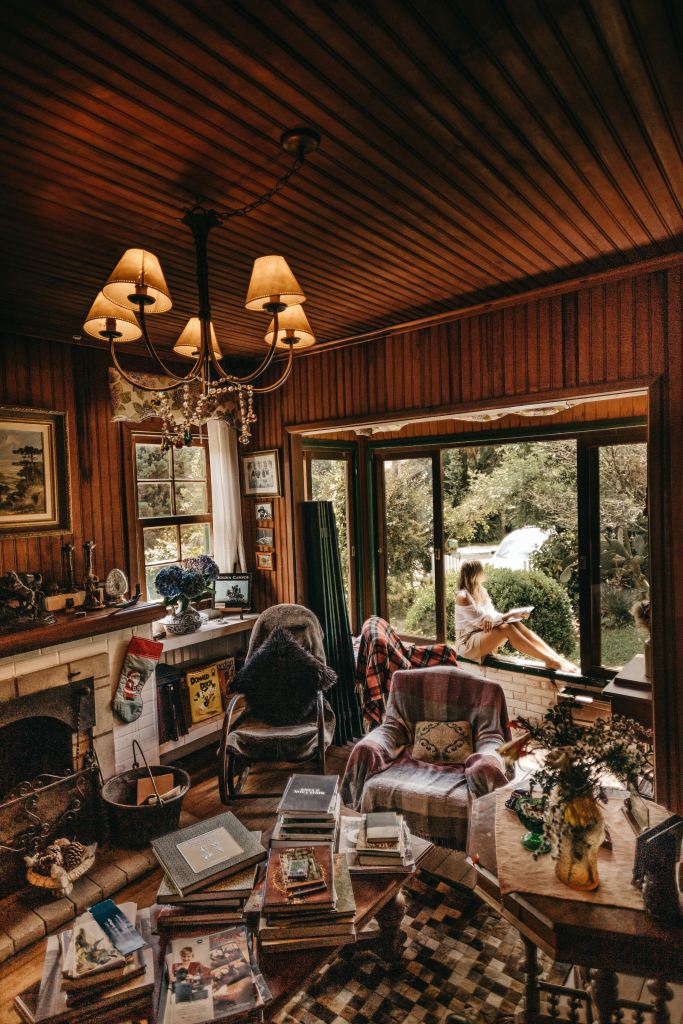
Novella-in-Flash Writing Prompt #17 – Landscape & Location as a Dynamic Story-Engine

Vivid locations, deftly sketched, are part of the contract we establish with readers that our story is authentic. Especially in long-form fiction, they are one of the subtle supports for persuading the reader to suspend disbelief and immerse themselves in the story.

In one-off flash fictions, passages of description may sometimes be minimised, due to the compressed nature of that individual form. But in a novella-in-flash, your settings and locations can have a more meaningful role in building story and atmosphere, through the gradual accumulation of detail across chapters. Plotting out your settings and locations on a map can also be a fun way to bring to life the novella you are imagining.

It can be helpful to
think about your settings as if they were characters or entities in their own right. What’s more, a piece of description is always more than just description. It reflects the emotions and inner world of the protagonist or observer. The way human participants relate to their physical environment contains dynamic narrative potential.

Photo by Andre Benz on Unsplash

Vivid, specific and unusual details can make scenes feel alive. Flash fiction writer and editor Randall Brown refers to Charles Baxter’s concept of ‘defamiliarization’, encouraging writers to focus on what’s unfamiliar and atypical about a location, the aspects of a scene that seem idiosyncratic, rather than giving the reader predictable and predetermined details. (Randall Brown, Pocket Guide to Flash Fiction (Wynnewood: Matter Press, 2012), pp.128–136)

Invitation: Pick one of the following prompts and write a new scene/story for your novella, or (if you prefer!) try sketching out some “notes-towards-a-story”, perhaps via the creative mind-mapping technique that Liz Berry talks about in this article.

  • Take a character to a location/landscape that’s physically or emotionally dangerous or risky. How do they respond?
  • Show a character in a landscape that’s full of vitality/abundance or ruin/decay. How do they respond emotionally? How are they prompted to interact with it/act?
  • Write a story where a character crosses or fails to cross a boundary of some kind (to go somewhere off-limits, forbidden or hidden)
  • Show a character settling down or choosing to settle down somewhere and treating this place as “home”. What emotions do they feel?
  • Show a character escaping/trying to escape/wanting to escape. What are they needing to escape? How are they feeling? Are they successful?
  • Show a character returning to somewhere that’s very familiar to them, after a long time away. What emotions do they feel?
  • Show a character arriving somewhere that’s completely new and unfamiliar to them. What emotions do they feel?
  • If your character(s) live(s) in a city, take them to the countryside (or vice versa). How do they feel in that new environment? How does it make them behave?

OPTIONAL: Consider using vivid, specific and unusual detail to bring to life the spirit of the location itself, and explore a character’s reaction to (or interaction with) the location. By the end of the flash, does the character realise something (about their environment, or a relationship or their status in/connection to the world)?

Photo by pine watt on Unsplash


Above all, “make it new”!

==================================

Don’t want to miss this blogpost series? Sign up to receive each new post direct to your email in-box (and get access to exclusive offers on mentoring) here:

Join 264 other subscribers

Are you working on a novella-in-flash? Or wanting to write one? Find out more about Michael Loveday’s Novella-in-Flash mentoring: here.

Novella-in-Flash Writing Prompt #16 – Getting Your Characters Out of Their Comfort Zone

What happens in your storyworld when you throw your characters into unfamiliar situations or put them under pressure – how do they react?

Photo by Hu Chen on Unsplash


Think about which aspects of character a pressurised/unfamiliar situation might uncover:
(a) What flaws of theirs might be exposed?
(b) Or in what ways might they thrive unexpectedly?
(c) And what might then follow on from EITHER (a) OR (b), for the ongoing story?

Here are some methods for stretching your characters beyond their comfort zones:

  • Your character crosses a physical boundary of some kind (to go somewhere off-limits, forbidden or hidden)
    OR
  • A scene with a long-standing friend or a cherished relative is unsettled by a disagreement or conflict. Who loses their cool or gets rattled? What unexpected things are said?  

Photo by Stewart MacLean on Unsplash

OR

  • Your main character meets a stranger. What’s the mood – awkward? tense? confusing? surprising? What unexpected or disconcerting things does the character notice about the stranger? What words, if any, are spoken by them?
    OR
  • An encounter with a wild animal – an encounter that unsettles them or alters them in some small way (NB the animal could be a pet, if that pet might unsettle/alter them somehow, or else a wilder creature)
    OR
  • Your character breaks a previously established rule (this could mean transgressing a social convention/code, or officially breaking the law)
    OR
  • Your character comes into conflict with institutional power in some form (you might think in terms of government, judiciary, healthcare, educational, corporate, and so on)
    OR
  • Write about a character and a taboo/fetish/obsession
    OR
  • A character having a supernatural encounter or unsettling spiritual experience
    OR
  • Your protagonist meets a person / couple / social group that’s very different in some fundamental way from themselves. How does your character interact / react? Perhaps something awkward, tense, confusing or surprising happens?
    OR
  • Challenge your character(s) with a task, problem or role that’s beyond their current capabilities or natural skillset. What’s their unique response to this unique problem?
    OR
  • Throw your character(s) into an unfamiliar environment – perhaps one that feels incongruous for their core identity. (The classic “fish out of water” concept so beloved by Hollywood scriptwriters…)
    OR
  • An encounter with an enemy, rival or “frenemy”. Will it involve out-and-out conflict? Or will it be merely a banal encounter? Embarrassing? Awkward? Establish a mood that suits your overall story.

Invitation: Pick one of the above prompts and write a new scene/story for your novella, or (if you prefer!) try sketching out some “notes-towards-a-story”.

OPTIONAL EXTRA: Pick more than one prompt from the above list, and put your character(s) under pressure several times across multiple scenes!

OPTIONAL EXTRA: When describing performance under pressure, people sometimes distinguish between “comfort zone”, “stretch zone”, and “panic zone”. Do the implications of these categories have any bearing on the situation for your character? Or are there other relevant names you would use for “zones” you would push your character into?

OPTIONAL EXTRA: Ernest Hemingway, in an interview with Dorothy Parker for the New Yorker, once defined courage as “grace under pressure.” What one main quality does your character exhibit when under pressure here? Might it be something completely different from Hemingway’s concept of “grace under pressure”?

Photo by Ryan Snaadt on Unsplash


Above all, “make it new”!

==================================

Don’t want to miss this blogpost series? Sign up to receive each new post direct to your email in-box (and get access to exclusive offers on mentoring) here:

Join 264 other subscribers

Are you working on a novella-in-flash? Or wanting to write one? Find out more about Michael Loveday’s Novella-in-Flash mentoring: here.

Novella-in-Flash Writing Prompt #15 – The Power of Triangles

The following three-part flash fiction – ‘Clean Magic’, by the stellar Francine Witte – offers the reader three different windows into its story-world.

The first part, from the third-person perspective of a jilted male lover, includes a non-realist element that feels like it’s been drawn from the territory of dark fairy tales, or some magical realist novel that’s playfully grotesque or absurd. The physical damage described is so fantastically extreme that it transcends literal meaning – it is signalling that it is meant to be interpreted playfully and symbolically.

The second section, in the first-person voice of a female aggressor mentioned in the first part of the story, enriches part one by revealing, through backstory, that the woman’s violence (as reported by the man) was enacting a kind of “pay-it-forward” retaliation.

And the third and final perspective in the story, arguably the strangest, gives voice to a “magic[al]” rock. It explores some of the thematic material of parts one and two from an unexpected angle, and reaches for wisdom (“it has to pass in its own measured way”) in a way that transcends the limited views of the man and woman in parts one and two.

The three part structure makes the story-world “three-dimensional”, as though this story were a chair that wouldn’t be fully itself if it had only one or two legs. Each perspective feels different in dramatic terms, because each of the characters has their own motives, values, and needs. Each character is given, at the very least, a hint of a backstory. There is variation between first- and third-person voice. Each new part takes an element from the preceding section and develops it. And the first and third sections are notably strange, conjuring an uneasy atmosphere in the midst of the playfulness (even the talking rock, something that might otherwise seem like a device for comedy, is “trapped”, “trick[ed]”, and “gag[ged]”).

Triangles of connected characters are useful to introduce into our writing, perhaps especially for longer stories, novels, or novellas. The push and pull of power dynamics (loyalties, allegiances, rivalries, hierarchies) between three people can be in flux more often than feels possible with only two people. Harold Pinter’s play ‘The Caretaker is a classic example of a writer exploring an unstable triangle – one in which a visitor to someone’s home is never quite sure where they stand, because they have to deal with two brothers whose relationship always seems to be changing.

Invitation: How might you introduce/develop a triangle of characters within your novella? What might be the shifting power dynamics between those three figures, over time?

Here’s Francine Witte’s story again to enjoy: ‘Clean Magic’

After reading Francine Witte’s flash fiction, adapt any of the following prompts to fit your novella’s storyline. Write a scene/chapter/story that features:

Three radically different points of view. (As your focus, find and use a key moment in the action of the overall novella, a decisive event that merits investigation from multiple angles.) Give each character their own differentiated motives, values, and needs in relation to this decisive event. Conjure a backstory for each figure, even if only a small part of their backstory features in the final draft. OPTIONAL: Let the second and third perspectives gradually reveal something new about the limitations of the previous perspective(s), in terms of how they understand the decisive event.

OR

• Write a story including an element of “cartoon violence” drawn from the world of folk/fairy tale, where bizarre, macabre injury, mutilation, blinding, or physical disabling, which would be tragic in all other contexts, is grotesquely commonplace as a deliberately playful or subversive device. (If it feels like this element might not suit your novella’s tone, consider featuring it within a dream or vision, which may helpfully lighten and justify the effect.)

OR

• Write a story featuring a non-violent retaliation that’s paid forward – where someone is passing the parcel of emotional suffering. OPTIONAL: Write it in such a way that the reader sympathises with both the victim and the aggressor.

OR

• Write a story entirely from the point of view of a non-human object – a spirit trapped within an inanimate physical form. OPTIONAL: this object is a witness to some of the human characters in the novella’s story-world, and it offers opinions about them, as well as foregrounding its own priorities.

• If it helps, use the symbolism of the following picture as a way into the material:


Above all, “make it new”!

More about Francine Witte’s writing here: FrancineWitte.com.

==================================

Don’t want to miss this blogpost series? Sign up to receive each new post direct to your email in-box (and get access to exclusive offers on mentoring) here:

Join 264 other subscribers

Are you working on a novella-in-flash? Or wanting to write one? Find out more about Michael Loveday’s Novella-in-Flash mentoring: here.