
This month, novella-in-flash.com features an interview with the writer Karen Jones. Karen’s novella-in-flash Burn It All Down was published by Arroyo Seco Press in April this year.

Michael: Welcome to this blog series, Karen. I’m so pleased to feature you and your recent novella-in-flash here. The book has a very unusual idea at its core, and I’m eager for more readers to find out about it – and to learn from how you managed to write it! It’s such an unusual book because it seems to have derived entirely from the oeuvre of a single artist – Andrea Kowch. You’ve imagined a whole story-world based on your interpretations of the artist’s recurring preoccupations and visual motifs: an ekphrastic novella-in-flash.
This is the very first time I’ve encountered a novella-in-flash based entirely on someone else’s artistic oeuvre. And these are not real-life or realistic images, they are very much in another mode. So I think it’s an extraordinary thing to have made a unified novella from the images, and you have delivered the concept so brilliantly.
I understand that the seeds for the project began with the wonderful Kathy Fish, one of the flash fiction community’s best-known writers and tutors, who introduced you to the artist’s work in a writing workshop. Can you tell us a bit more about how you moved from this first step into thinking: maybe I can write a whole book inspired by this artist’s images?
Karen: Hi Michael – thanks for inviting me to the blog. Yes, that’s right, I first saw Andrea Kowch’s work in a Kathy Fish flash class. The painting Kathy used was called In the Distance and I loved everything about it, but especially the woman in the kitchen, who, to me, looked frustrated and desperate to escape. I wrote what ended up being the title story for the N-i-F from that painting and then sought out more of Kowch’s art. Every painting I looked at sparked a story and I used two of them Chosen and The Cape as inspiration for another two flashes in that same Kathy Fish course. Kathy and the other participants loved the flashes I’d written, and their reaction gave me confidence. I became a bit obsessed with Kowch’s art after that and the more I saw the more I wrote, always centred on that original character, which convinced me I could attempt a N-i-F based on the characters – and animals – in those weird and wonderful paintings.
Michael: What was it that interested you specifically about going further with these particular characters?
Karen: One of the things I love about Andrea Kowch’s work is how full the paintings are – every time you look, you see something you missed the first time. For example, in the painting No Turning Back, I didn’t notice on a first glance that the tree in the distance is blowing at an angle almost identical to the way the woman’s hair is blowing. And in fact, I didn’t even notice her hat blowing the first time, because I was so engrossed in the woman and the tethers around her wrists and what that could mean. From a writing point of view, that meant I could home in on one aspect of a painting for one story and another for the next, so sometimes one painting could trigger several stories.
But it was the women in her paintings that really made me feel there was a bigger, connected story there. They all have wild, untameable hair, which made me think they could be related. In the second story I wrote, I decided they were sisters, and once I had that family connection, a N-i-F felt like a possibility.
There are rarely men in the paintings, and when there are, they’re in the background, so these women, living in this ramshackle house on the edge of the sea (the house can be seen in The Cape), the house often filled with animals and insects, fascinated me. How were they surviving, where were their parents/other family? Why did they have this affinity with animals? I often write surreal stories about odd people – people on the edges of society – and these women and how they are presented in the artwork lent themselves to that perfectly.
I’d never tried to tackle that in N-i-F form, so I knew it would be a challenge, but I loved every moment of teasing out their story. I didn’t plan – didn’t know at the start how the story would end – so I just let it unfold naturally with each story I wrote. I brought in other characters, though not many, to resolve the questions I had about the sisters, and I wrote quickly, not allowing myself to stop and edit.
Michael: It sounds like the visual material raised active questions for you about the potential story context (e.g. where are these characters’ parents? Why aren’t they ever present in these images?), and as you gradually imagined specific answers (“What if they…?”) to these questions, this sparked clarifications of the situation the sisters are in, and it led to new stories, or to additional texture in the existing stories? Perhaps this is a good model for all kinds of story generation for an extended piece of fiction, even when not working with images: asking questions of your characters, and especially scrutinising the gaps: the things you don’t know about them. And then following the specific answers like a trail, even imagining new scenes based on what you’re discovering…
Karen: Yes, definitely. All the questions and ‘what-ifs’ are, for me, hugely important. With this story in particular, because the paintings are so full of detail and so strange, I ended up with several answers to each question. Some of the answers proved to be dead ends and I didn’t feel I could sustain a whole novella-in-flash if I followed certain threads, for example, before I made them sisters I had them in my head as friends, but I felt I needed them to live together, to be in that house and in those fields together always to really capture their lives. At one point I even thought of setting the N-i-F in Scotland, but I got caught up in the kinds of animals and insects that surround the woman, many of which wouldn’t be found in Scotland, so I had to abandon that idea. But once I’d identified the threads and ideas that allowed for further character development, for the possibility of several endings, I narrowed it down to the version that interested me most – the one I thought (hoped) I could bring to a satisfying conclusion. But having those other possibilities served as a safety net, that I could go back and take a different route if I had to.
I was very aware that someone else looking at the paintings could see an entirely different story, but I had to put that out of my mind and go with what felt right for me. I was particularly drawn to the paintings that involved fire in some way, whether to the forefront or in the distance, and it was those paintings that ultimately led me to how the story would end. I write very quickly once I get a story in my head, so having decided who the characters were and which specific paintings I wanted to work with, I wrote it and submitted it in about ten days. I know that flies in the face of the advice about leaving a story for several weeks before going back to edit, but sometimes I just know when something is right and that I could do more harm than good if I tinker with it endlessly. I find that to be particularly true with ekphrastic writing – if an image grabs me and sparks a story, I prefer to let the first draft stand, other than checking for typos etc.
The title story, ‘Burn It All Down’, won second prize in Fractured Lit’s micro competition in 2022. It was the first story I wrote from the artist’s work, so it was a huge boost to have it win a prize and made me more confident that I was onto something with these characters and that the woman in that painting (In the Distance) who I named Beth, would be my main character. It was the same with my first N-i-F, When It’s not Called Making Love – only one flash had been previously published. I know some publishers allow and want a percentage of previously published stories but I was lucky in that it turned out not to be an issue for me. I am working, very slowly, on another couple of N-i-Fs and one of them has come from several previously published stories, so I’ll have to check guidelines when it’s ready.

I know lots of authors who’ve started a N-i-F by looking at a whole bunch of previously published stuff and finding any commonalities, whether in theme or character, to give them a base to start from, but my brain doesn’t seem to work that way – I work better when I’m doing almost the whole project from scratch. I think I’d struggle to make links between stories seem natural if I tried it the other way – like everything would seem shoehorned in and hanging together tenuously. I’m full of admiration for writers who can make previously published stories appear seamless as a longer work.
Michael: Yes, I remember Ingrid Jendrzejewski talking about that to Ad Hoc Fiction in the context of her “found” novella-in-flash Things I Dream About When I’m Not Sleeping (published within the anthology How to Make a Window Snake (Ad Hoc Fiction, 2017)). It sounded like a fascinating process of discovery and curation for her.
So, having spoken about your superb ekphrastic book here (which I hope readers of this blog will now seek out!), shall we leave readers with an ekphrastic writing prompt they can experiment with?
One resource I’ve previously found helpful in preparing for ekphrastic writing is Martyn Crucefix’s categorisation of ekphrastic writing strategies. Although his summary is intended to be about poems, it can often work for flash fiction too. And of course there’s the wonderful, inexhaustible resource of The Ekphrastic Review founded by Lorette C. Luzajic, and ekphrastic writing workshops by Anika Carpenter.
Karen, is there a picture or resource or a particular artist you’d like to share with readers, such that they could be inspired to try a piece of ekphrastic writing, and see where it leads them?
Karen: I’ve always loved these Magritte paintings ‘The Lovers’. Following on from what Michael and I have said about the questions a piece of art can throw up (all the ‘what ifs’), try working with the two images below:
(1) list some questions you have about the situations in the pictures and then
(2) try coming up with some possible answers to these questions.
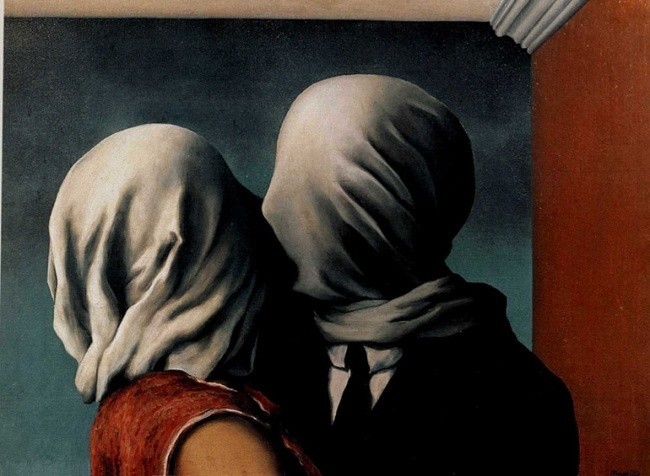
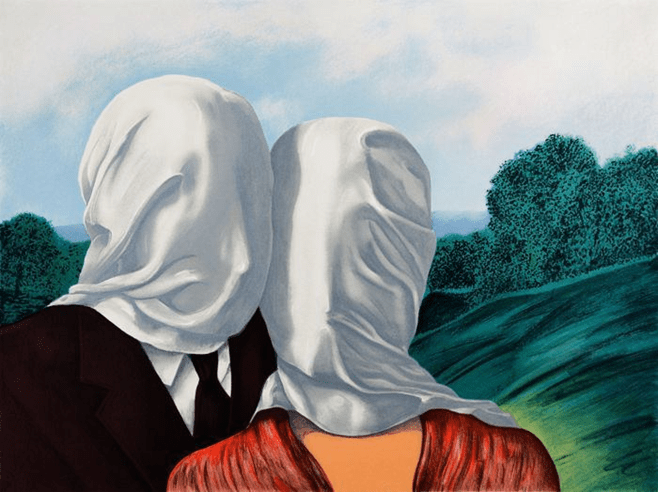
Choose a couple of your questions/answers and write one or two draft flashes. This might bring more questions, which is a great way to start working on a series of flashes or even a N-i-F. And then you might continue the sequence by seeking out other Magritte paintings.
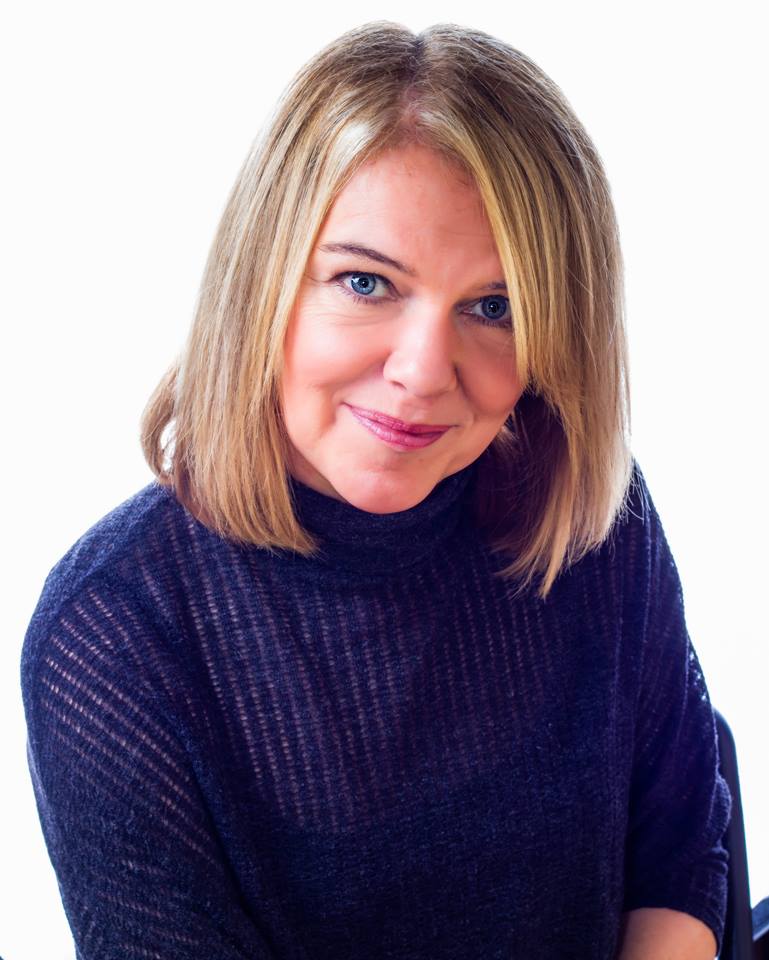
Karen Jones Biography – Karen Jones is a flash and short fiction writer from Glasgow, Scotland. Her flashes have been nominated for Best of the Net and The Pushcart Prize, and her story Small Mercies was included in Best Small Fictions 2019. She has won first prize in the Cambridge Flash Prize, Flash 500 and Reflex Fiction and second prize in Fractured Lit’s Micro Fiction Competition. Her work has been Highly Commended/shortlisted for To Hull and Back, Bath Flash Fiction, Bath Short Story Award and many others. Her first novella-in-flash When It’s Not Called Making Love is published by Ad Hoc Fiction, and her second, Burn It All Down, is published by Arroyo Seco Press. She is an editor for National Flash Fiction Day anthology.
==================================
Don’t want to miss this blogpost series? Sign up to receive each new post direct to your email in-box (and get access to exclusive offers on mentoring) here:
Are you working on a novella-in-flash? Or wanting to write one? Find out more about Michael Loveday’s Novella-in-Flash mentoring: here.
 The Novella-in-Flash