Novella-in-Flash Writing Prompt #19 – Going Further with Landscape & Location (via the poetry of Michael Longley)

Today’s blogpost develops the recent theme of going further with the settings you use in your writing. We’ll approach the topic from a fresh angle by exploring the work of the Anglo-Irish poet Michael Longley, to see what can be learned from him more generally for writing about physical environments of all kinds. (NB See here and here for two other recent blogposts about making the most of settings in your writing).

For those who don’t know Longley’s writing – a brief intro…

Longley was born in Belfast in 1939 and worked in Belfast, Dublin, and London before retirement. Along with Seamus Heaney, Derek Mahon and others, he has been celebrated as part of the remarkable cohort of Irish writers revitalising poetry from the 1960s onwards. Although all of his books contain outstanding poems, his collections during the period from Gorse Fires (1991), through The Ghost Orchid (1995), to The Weather in Japan (2000) are – for this reader at least – particularly worth seeking out, as they contain perhaps his most consistently brilliant work. He is known for his poems responding to The Troubles, for his translations of Homer and other classical poets (often speaking obliquely, as in this example, about modern conflict through ancient texts), and for writing about the First World War (in which his father fought), but if there is one subject he has returned to even more frequently than all of these, it is the physical landscape of Carrigskeewaun, in County Mayo in the West of Ireland, where Longley – throughout his life – has made regular visits to stay in a remote cottage belonging to a friend.

Michael Longley, Collected Poems (London: Jonathan Cape, 2007)

Over the years of reading Longley’s poetry, I’ve returned to his poems about Carrigskeewaun repeatedly, wondering what it is that beguiles me on the page and keeps me reading. What is it that elevates these poems beyond the routine tropes of pastoral poetry?

In what follows, I’m aiming to uncover some strategies we might apply to writing about landscapes and locations of all kinds, including the urban…

(1) For me, a core part of what makes Longley special is that he has become very strongly associated with that one particular place, Carrigskeewaun, and has tried to extract every small drop of meaning from exploring it. (We might be using any location as an example here, but in this instance, we are talking about an area that – in Longley’s poems – includes farmland and seashore, populated by rich plant and animal life, yet also possessing some of the qualities of a remote wilderness: as Michael Viney puts it here, it’s “a primal-seeming no-man’s-land of rock and sand-dune, sandy machair, sandy lakes, cliffs dark with ivy, a wild topography brooded over by Mweelrea Mountain and hemmed around by sea.”) Longley has written of his connection to the place as follows: “I fell in love with Carrigskeewaun the first time I saw it more than thirty years ago from the turn in the road above Thallabaun…I’m still only scratching the surface. Carrigskeewaun provides me with the template for experiencing all other places and keeps me sensitive, I hope, to the nuances of locality.”

Invitation #1: As writers, whether we are most drawn to write about rural or urban settings, we could be inspired by Longley’s example to become fascinated by a particular kind of territory, and to root our writing somewhere recurringly (even if, as with Longley, it’s not where we live). What might happen in our writing if we explore a particular type of physical situation especially deeply? What might that specific location be in your case? Or maybe instead it’s a type of location you’re fascinated by – ports, airports, churches, mosques, rivers, bridges, hospitals, nightclubs, schools, factories, farms, solar farms, and so on. How might you develop what might be called a “productive obsession” in your writing?

(2) Another part of the answer, for me, is that Longley scrutinises landscapes with the triple-eye of a botanist, ornithologist, and zoologist all rolled into one. In his poems he is a model of good practice for “the writer as witness”, a mindset and responsibility that transcends subject matter, genre or literary form. Such a detailed witnessing and understanding of landscape, including a deep knowledge of its associated shapes and vocabulary, is not a skill we are born with – it’s something acquired through diligent study and a lifetime of accumulation. Longley, for example, gained much of his knowledge of botany via a 40-year friendship with the painter of orchids Raymond Piper.

Invitation #2: How might we as writers become more devoted to learning about the physical world we inhabit? If you’re interested in urban spaces, might you research cities as a physical phenomenon? Or the architecture of individual buildings? If you’re interested in rural places, how might you be inspired to strengthen your knowledge of natural forms? In short, how might we all delve even more deeply into the phenomena of the physical world, as Longley has?

Westport, County Mayo (Photo by Phil Aicken on Unsplash)

(3) Furthermore, Longley is particularly good at manifesting competing impulses within his depictions of landscape: abundance and entropy, tenderness and brutality. Time and time again, his descriptions of settings contain shades of nuance, doubleness and complexity.

By way of example, here, in the first short section (‘The Mountain’) of this poem sequence called ‘Carrigskeewaun’, the morbid “skulls, bones… [and] marrow” offer a stark and incongruous contrast with the innocence of “children… and picnic things.”

And here, in ‘Between Hovers’, what could be purely a bleak narrative about a dead badger and a dead otter is suspended within a balanced framework that is “floodlit… [with] filament[s] of light… [and] sparkle…”, includes reference to “a spring tide”, and moves towards a closing image suggestive of transcendence.

Invitation #3: Where might you find opportunities, in your own writing, to remain open to complexity, by finding in your landscapes/locations contrasting aspects of both vitality and decay? Or a fluidity between gentleness and harshness?

(4) Lastly, Longley often places human experience within the context of the natural, or frames the natural world within the context of the human. He does this by effortlessly setting human and natural objects side by side within his landscapes, or else by deploying particular verbs or nouns as metaphors to make the natural and the human seem even more deeply intertwined.

Here, in ‘The Strand’ (part of the ‘Carrigskeewaun’ sequence again), the trails of a bird, children, and the narrator are all shown to be physically interconnected with and adjacent to the sand dunes and the seashore:

      ”….a sanderling’s tiny trail,
The footprints of the children and my own
Linking the dunes to the water’s edge…”

And here, in ‘The Leveret, we can see Longley toying with individual word choices to mix up ideas of the human (or human-built) and the natural: the conception of a baby is a “fire-seed”, young birds are a “sootfall”, and the leveret takes “breakfast”, an image that seems, in this context, very humanised.

Invitation #4: In your own writing, might you experiment with juxtaposing/blurring the natural and the human, through your choices of objects, symbols and metaphors? Might you, for example, experiment with using verbs that humanise your physical settings, or make your descriptions of people seem more animal-like, in an artful way?

One Final Invitation: In the coming days, why not carve out a bit more time to linger with Longley’s poems (there are some further links below…) and then return to your novella-in-flash (or any other writing project – a short story, a set of poems, a novel), and explore ways to transform your writing. In what new and subtle ways might it become a treasure house of encounters with the physical world that surrounds us…

Michael Longley: ‘Remembering Carrigskeewaun’

Michael Longley: ‘The West’

Michael Longley: Selected Other Poems

==================================

Don’t want to miss this blogpost series? Sign up to receive each new post direct to your email in-box (and get access to exclusive offers on mentoring) here:

Join 264 other subscribers

Are you working on a novella-in-flash? Or wanting to write one? Find out more about Michael Loveday’s Novella-in-Flash mentoring: here.

Novella-in-Flash Writing Prompt #18 – Going Further with Landscape & Location

Recently I’ve been considering this principle more than ever before: the action of writing about place is always political. This truth perhaps feels like it has even greater and more tragic resonance in our current era, where landscapes are territories strongly contested by multiple forces, yet it has manifested in so many different ways throughout centuries of world literature.

Some writers already have an inherently politicised relationship with landscape because of their personal connection to a particular location – whether as a birthplace, or as “home turf”, somewhere that a person has rooted, or somewhere our ancestors were rooted.

Not all writers feel they have a readily personal link to physical landscapes that contain deeper, political resonances. Depending on where we live or have lived, we might feel like the physical settings we’re most connected to are too ordinary.

And yet, and yet…

Photo by Edi Libedinsky on Unsplash

It’s a surprising truth that what feels like ordinary territory to one person can be astonishing or revelatory to an outsider who isn’t familiar with that place. Our ordinary can be someone else’s extraordinary, because sometimes we overlook what’s notable about the everyday world that surrounds us. Sometimes, too, our families or communities connect us to landscapes in deeper, more entangled ways than we conceptualise when we’re simply going about our daily life.

And ultimately every landscape, whether rural or urban, is inscribed with both a natural and a human history that is fundamentally political – not just the history of animal and plant life that has flourished or waned there, but also the history of our human relationship with that land, and how we have interacted with it over time (through agricultural machinery, or buildings, patterns of mapping, or physical sculpting and reshaping, or sometimes merely in the act of walking through it). Landscape in this way becomes more than only a physical territory: it contains layers of history, politics (local, national, or international), and story.

Photo by Silas Baisch on Unsplash

Invitation #1: Here are some questions to get you exploring your own personal connection to landscape and place. I invite you to find a spare 30-40 minutes or so (this weekend or at another time), and write out some reflections in response. And then whatever themes emerge, be open to the possibility of new ideas percolating their way into your current writing projects:

  • In what kinds of environments have you lived and worked? (In other words, the places where you have rooted, to a greater or lesser extent.)
  • To what kinds of environments have you travelled?
  • Do you consider yourself a rural or urban person, in your upbringing?
  • Which type of environment – rural or urban – has the stronger or more positive associations for you now, and why?
  • To what extent do you consider yourself rooted (or rootless)?
  • What are the racial, ethnic or national identities that have shaped your experience of place, and in what ways?
  • How have broader environmental issues (climate, food, wildlife, housing etc) affected your life, or the lives of people you know personally?
  • How would you describe your relationship to the planet as a whole?
  • What are the key incidents and influences from your life through which place or environment have had an impact upon your identity?

TIP: As well as containing story, a landscape will also inevitably carry layers of emotion. As Graham Mort has written, in his brilliant essay ‘Landscapes and Language’: “A landscape poem or descriptive prose passage is always more than pure description… Landscapes in this respect are psyche-scapes, metaphors representing the yearnings and aspirations, hope, betrayal, anger and bitterness that we see in them.” (from The Creative Writing Coursebook, Julia Bell & Paul Magrs (eds.), (London: Macmillan, 2001), p.180). So as you start making notes about landscapes you’re personally connected to, notice any feelings associated with them, as well as simply trying to witness their physical existence. (If you notice challenging feelings arising, you have the freedom to decide to keep writing through the feeling until it transforms or subsides, or otherwise pause and distract yourself with another activity, chat to someone, or go for a stroll / get your body moving.)

Photo by Steven Wright on Unsplash

Invitation #2: As a second activity this weekend (or at a more convenient time for you), I invite you to go out into your local landscape with a notebook or smartphone and practise the following two-part exercise as an act of witnessing: (a) observing the physical reality of things closely, and (b) finding vivid and specific language for capturing/evoking those physical things on the page. Consider the following categories of noticing, if they’re helpful:

(1) details of nature (incl. any interaction between “natural” and “human”)
(2) architecture (incl. decorative vs. functional vs. culturally symbolic or meaningful; and manifestations of the passage of time within architecture)
(3) people – as individuals and people in groups (e.g. why this person with these people as a group? clothes as a statement/unconscious signal; what is the person carrying and why? what are the person’s emotions? what kind of activity are they participating in?)
(4) technology/equipment (its purpose, what materials is the technology using, how it might have been made, and by whom, and what effect does it have on its surroundings?)

Again, afterwards, be open to some of this observed material finding its way into your current writing projects…

Above all, have fun exploring the landscapes and locations you personally know. Consider them as if you were seeing the territory for the first time…

==================================

Don’t want to miss this blogpost series? Sign up to receive each new post direct to your email in-box (and get access to exclusive offers on mentoring) here:

Join 264 other subscribers

Are you working on a novella-in-flash? Or wanting to write one? Find out more about Michael Loveday’s Novella-in-Flash mentoring: here.
Novella-in-Flash Writing Prompt #17 – Landscape & Location as a Dynamic Story-Engine

Vivid locations, deftly sketched, are part of the contract we establish with readers that our story is authentic. Especially in long-form fiction, they are one of the subtle supports for persuading the reader to suspend disbelief and immerse themselves in the story.

In one-off flash fictions, passages of description may sometimes be minimised, due to the compressed nature of that individual form. But in a novella-in-flash, your settings and locations can have a more meaningful role in building story and atmosphere, through the gradual accumulation of detail across chapters. Plotting out your settings and locations on a map can also be a fun way to bring to life the novella you are imagining.

It can be helpful to
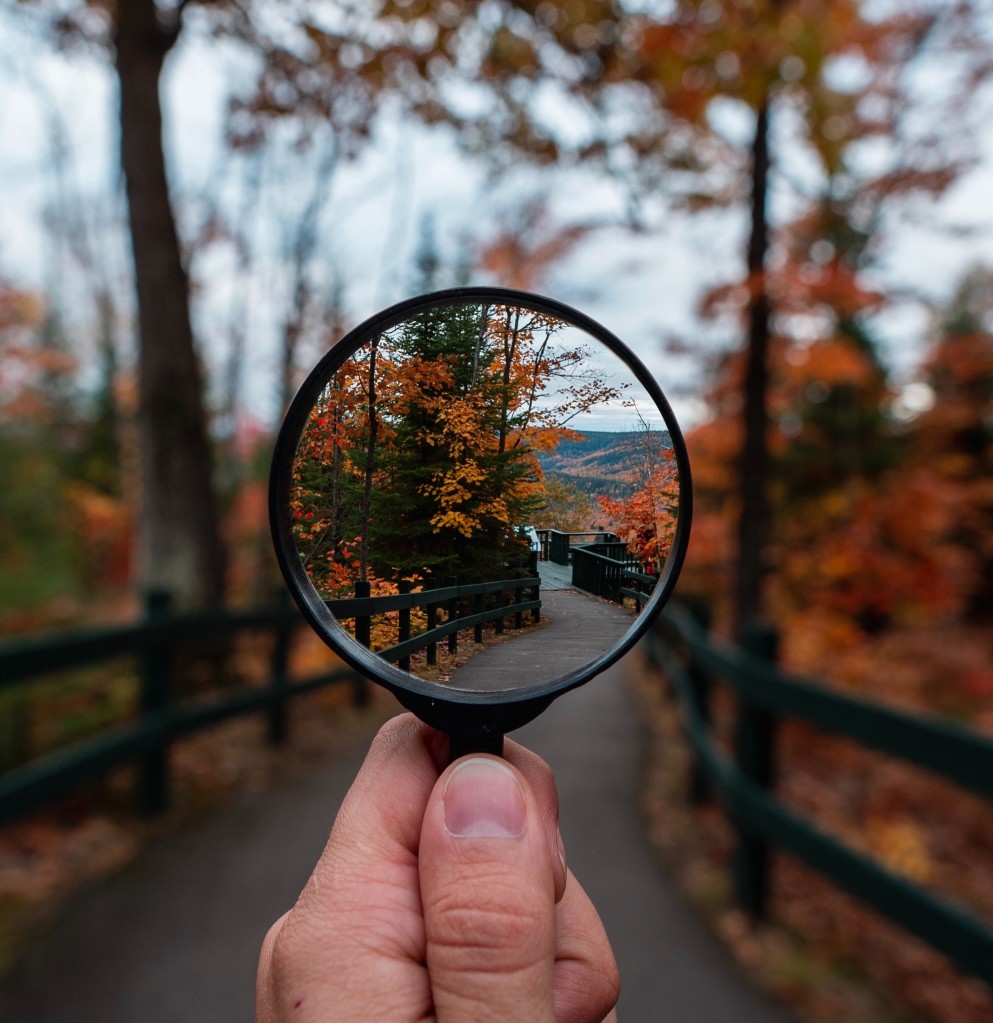
think about your settings as if they were characters or entities in their own right. What’s more, a piece of description is always more than just description. It reflects the emotions and inner world of the protagonist or observer. The way human participants relate to their physical environment contains dynamic narrative potential.

Photo by Andre Benz on Unsplash

Vivid, specific and unusual details can make scenes feel alive. Flash fiction writer and editor Randall Brown refers to Charles Baxter’s concept of ‘defamiliarization’, encouraging writers to focus on what’s unfamiliar and atypical about a location, the aspects of a scene that seem idiosyncratic, rather than giving the reader predictable and predetermined details. (Randall Brown, Pocket Guide to Flash Fiction (Wynnewood: Matter Press, 2012), pp.128–136)

Invitation: Pick one of the following prompts and write a new scene/story for your novella, or (if you prefer!) try sketching out some “notes-towards-a-story”, perhaps via the creative mind-mapping technique that Liz Berry talks about in this article.

  • Take a character to a location/landscape that’s physically or emotionally dangerous or risky. How do they respond?
  • Show a character in a landscape that’s full of vitality/abundance or ruin/decay. How do they respond emotionally? How are they prompted to interact with it/act?
  • Write a story where a character crosses or fails to cross a boundary of some kind (to go somewhere off-limits, forbidden or hidden)
  • Show a character settling down or choosing to settle down somewhere and treating this place as “home”. What emotions do they feel?
  • Show a character escaping/trying to escape/wanting to escape. What are they needing to escape? How are they feeling? Are they successful?
  • Show a character returning to somewhere that’s very familiar to them, after a long time away. What emotions do they feel?
  • Show a character arriving somewhere that’s completely new and unfamiliar to them. What emotions do they feel?
  • If your character(s) live(s) in a city, take them to the countryside (or vice versa). How do they feel in that new environment? How does it make them behave?

OPTIONAL: Consider using vivid, specific and unusual detail to bring to life the spirit of the location itself, and explore a character’s reaction to (or interaction with) the location. By the end of the flash, does the character realise something (about their environment, or a relationship or their status in/connection to the world)?

Photo by pine watt on Unsplash


Above all, “make it new”!

==================================

Don’t want to miss this blogpost series? Sign up to receive each new post direct to your email in-box (and get access to exclusive offers on mentoring) here:

Join 264 other subscribers

Are you working on a novella-in-flash? Or wanting to write one? Find out more about Michael Loveday’s Novella-in-Flash mentoring: here.