Here’s a really engaging and powerful piece of short prose by Isaman Cann (Michelle Jones) published in Star 82 Review, one of those long-running journals that flies under the radar and keeps publishing excellent writing year after year:
This story struck me when I first read it, in early January, because the arrival of a New Year has often – in the old tradition – prompted people to make New Plans: to introduce new habits/regimes/objectives, to start a new health kick, or to explore new experiences. And Cann’s micro – although not about New Year as such – amused me because it was exploring a different kind of mindset, an ‘anti-heroic’ or ‘anti-achiever’ one. The narrator is at a stage in life when they feel like it’s “time to generally lower the standards”. I loved how, after this initially amusing tone, the story ended up somewhere quite existential and poignant by the end, in only a few lines.
This piece also got me thinking about the different ways in which we can get to know the main characters in our writing – especially when we are working on a novella-in-flash (or any piece of long-form fiction).
In this piece, the narrator is talking about their relationship with exercise, specifically running in this instance. This is a way for the character/narrator to convey to the reader their relationship with their body. And it’s also a way for the character to convey their relationship with themselves.
For your novella-in-flash, have you thought yet about how your main character feels about their physical self? About their experience of their own body?
Invitation #1: Why not do some freewriting (in first-person POV) about this aspect of your main character’s identity – their relationship with their physical self?
Invitation #2: How might your insights into your main character’s experience of their own body be threaded into the chapters you’ve already written/planned for your novella? Take some time to brainstorm some notes.
And once you’ve done some freewriting, here are some prompts you might use to get going with a story for your novella-in-flash, following Isaman Cann’s story:
This month, novella-in-flash.com features an interview with the writer Karen Jones. Karen’s novella-in-flash Burn It All Down was published by Arroyo Seco Press in April this year.
Michael: Welcome to this blog series, Karen. I’m so pleased to feature you and your recent novella-in-flash here. The book has a very unusual idea at its core, and I’m eager for more readers to find out about it – and to learn from how you managed to write it! It’s such an unusual book because it seems to have derived entirely from the oeuvre of a single artist – Andrea Kowch. You’ve imagined a whole story-world based on your interpretations of the artist’s recurring preoccupations and visual motifs: an ekphrastic novella-in-flash.
This is the very first time I’ve encountered a novella-in-flash based entirely on someone else’s artistic oeuvre. And these are not real-life or realistic images, they are very much in another mode. So I think it’s an extraordinary thing to have made a unified novella from the images, and you have delivered the concept so brilliantly.
I understand that the seeds for the project began with the wonderful Kathy Fish, one of the flash fiction community’s best-known writers and tutors, who introduced you to the artist’s work in a writing workshop. Can you tell us a bit more about how you moved from this first step into thinking: maybe I can write a whole book inspired by this artist’s images? Karen: Hi Michael – thanks for inviting me to the blog. Yes, that’s right, I first saw Andrea Kowch’s work in a Kathy Fish flash class. The painting Kathy used was called In the Distance and I loved everything about it, but especially the woman in the kitchen, who, to me, looked frustrated and desperate to escape. I wrote what ended up being the title story for the N-i-F from that painting and then sought out more of Kowch’s art. Every painting I looked at sparked a story and I used two of them Chosen and The Cape as inspiration for another two flashes in that same Kathy Fish course. Kathy and the other participants loved the flashes I’d written, and their reaction gave me confidence. I became a bit obsessed with Kowch’s art after that and the more I saw the more I wrote, always centred on that original character, which convinced me I could attempt a N-i-F based on the characters – and animals – in those weird and wonderful paintings.
Michael: What was it that interested you specifically about going further with these particular characters?
Karen: One of the things I love about Andrea Kowch’s work is how full the paintings are – every time you look, you see something you missed the first time. For example, in the painting No Turning Back, I didn’t notice on a first glance that the tree in the distance is blowing at an angle almost identical to the way the woman’s hair is blowing. And in fact, I didn’t even notice her hat blowing the first time, because I was so engrossed in the woman and the tethers around her wrists and what that could mean. From a writing point of view, that meant I could home in on one aspect of a painting for one story and another for the next, so sometimes one painting could trigger several stories.
But it was the women in her paintings that really made me feel there was a bigger, connected story there. They all have wild, untameable hair, which made me think they could be related. In the second story I wrote, I decided they were sisters, and once I had that family connection, a N-i-F felt like a possibility.
There are rarely men in the paintings, and when there are, they’re in the background, so these women, living in this ramshackle house on the edge of the sea (the house can be seen in The Cape), the house often filled with animals and insects, fascinated me. How were they surviving, where were their parents/other family? Why did they have this affinity with animals? I often write surreal stories about odd people – people on the edges of society – and these women and how they are presented in the artwork lent themselves to that perfectly.
I’d never tried to tackle that in N-i-F form, so I knew it would be a challenge, but I loved every moment of teasing out their story. I didn’t plan – didn’t know at the start how the story would end – so I just let it unfold naturally with each story I wrote. I brought in other characters, though not many, to resolve the questions I had about the sisters, and I wrote quickly, not allowing myself to stop and edit.
Michael: It sounds like the visual material raised active questions for you about the potential story context (e.g. where are these characters’ parents? Why aren’t they ever present in these images?), and as you gradually imagined specific answers (“What if they…?”) to these questions, this sparked clarifications of the situation the sisters are in, and it led to new stories, or to additional texture in the existing stories? Perhaps this is a good model for all kinds of story generation for an extended piece of fiction, even when not working with images: asking questions of your characters, and especially scrutinising the gaps: the things you don’t know about them. And then following the specific answers like a trail, even imagining new scenes based on what you’re discovering…
Karen: Yes, definitely. All the questions and ‘what-ifs’ are, for me, hugely important. With this story in particular, because the paintings are so full of detail and so strange, I ended up with several answers to each question. Some of the answers proved to be dead ends and I didn’t feel I could sustain a whole novella-in-flash if I followed certain threads, for example, before I made them sisters I had them in my head as friends, but I felt I needed them to live together, to be in that house and in those fields together always to really capture their lives. At one point I even thought of setting the N-i-F in Scotland, but I got caught up in the kinds of animals and insects that surround the woman, many of which wouldn’t be found in Scotland, so I had to abandon that idea. But once I’d identified the threads and ideas that allowed for further character development, for the possibility of several endings, I narrowed it down to the version that interested me most – the one I thought (hoped) I could bring to a satisfying conclusion. But having those other possibilities served as a safety net, that I could go back and take a different route if I had to.
I was very aware that someone else looking at the paintings could see an entirely different story, but I had to put that out of my mind and go with what felt right for me. I was particularly drawn to the paintings that involved fire in some way, whether to the forefront or in the distance, and it was those paintings that ultimately led me to how the story would end. I write very quickly once I get a story in my head, so having decided who the characters were and which specific paintings I wanted to work with, I wrote it and submitted it in about ten days. I know that flies in the face of the advice about leaving a story for several weeks before going back to edit, but sometimes I just know when something is right and that I could do more harm than good if I tinker with it endlessly. I find that to be particularly true with ekphrastic writing – if an image grabs me and sparks a story, I prefer to let the first draft stand, other than checking for typos etc.
The title story, ‘Burn It All Down’, won second prize in Fractured Lit’s micro competition in 2022. It was the first story I wrote from the artist’s work, so it was a huge boost to have it win a prize and made me more confident that I was onto something with these characters and that the woman in that painting (In the Distance) who I named Beth, would be my main character. It was the same with my first N-i-F, When It’s not Called Making Love– only one flash had been previously published. I know some publishers allow and want a percentage of previously published stories but I was lucky in that it turned out not to be an issue for me. I am working, very slowly, on another couple of N-i-Fs and one of them has come from several previously published stories, so I’ll have to check guidelines when it’s ready.
I know lots of authors who’ve started a N-i-F by looking at a whole bunch of previously published stuff and finding any commonalities, whether in theme or character, to give them a base to start from, but my brain doesn’t seem to work that way – I work better when I’m doing almost the whole project from scratch. I think I’d struggle to make links between stories seem natural if I tried it the other way – like everything would seem shoehorned in and hanging together tenuously. I’m full of admiration for writers who can make previously published stories appear seamless as a longer work.
Michael: Yes, I remember Ingrid Jendrzejewski talking about that to Ad Hoc Fiction in the context of her “found” novella-in-flash Things I Dream About When I’m Not Sleeping (published within the anthology How to Make a Window Snake(Ad Hoc Fiction, 2017)). It sounded like a fascinating process of discovery and curation for her.
So, having spoken about your superb ekphrastic book here (which I hope readers of this blog will now seek out!), shall we leave readers with an ekphrastic writing prompt they can experiment with?
One resource I’ve previously found helpful in preparing for ekphrastic writing is Martyn Crucefix’s categorisation of ekphrastic writing strategies. Although his summary is intended to be about poems, it can often work for flash fiction too. And of course there’s the wonderful, inexhaustible resource of The Ekphrastic Review founded by Lorette C. Luzajic, and ekphrastic writing workshops by Anika Carpenter.
Karen, is there a picture or resource or a particular artist you’d like to share with readers, such that they could be inspired to try a piece of ekphrastic writing, and see where it leads them?
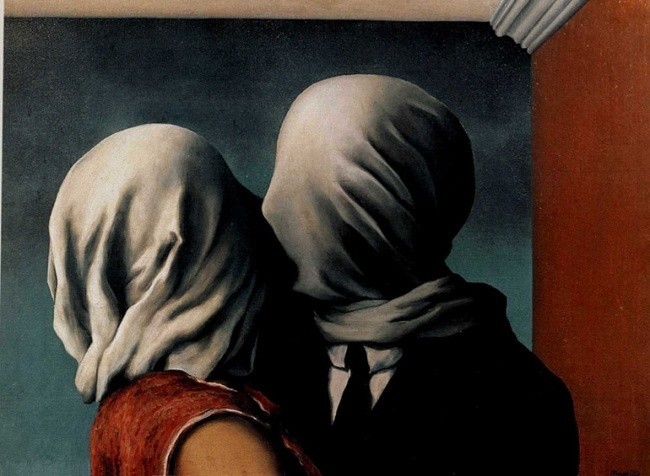
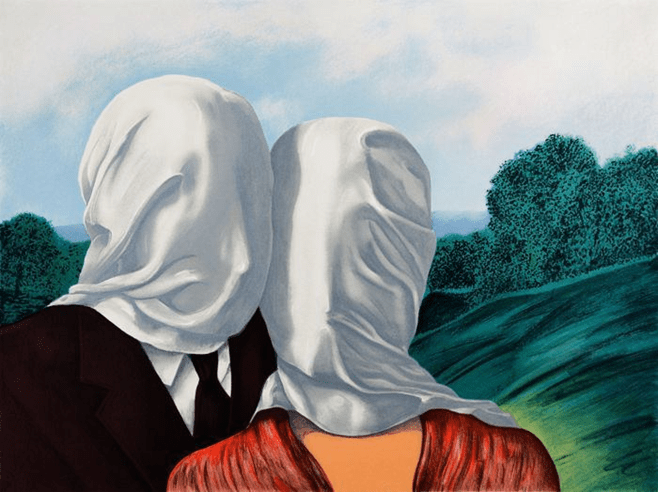
Karen: I’ve always loved these Magritte paintings ‘The Lovers’. Following on from what Michael and I have said about the questions a piece of art can throw up (all the ‘what ifs’), try working with the two images below:
(1) list some questions you have about the situations in the pictures and then (2) try coming up with some possible answers to these questions.
Choose a couple of your questions/answers and write one or two draft flashes. This might bring more questions, which is a great way to start working on a series of flashes or even a N-i-F. And then you might continue the sequence by seeking out other Magritte paintings.
Karen Jones Biography – Karen Jones is a flash and short fiction writer from Glasgow, Scotland. Her flashes have been nominated for Best of the Net and The Pushcart Prize, and her story Small Mercies was included in Best Small Fictions 2019. She has won first prize in the Cambridge Flash Prize, Flash 500 and Reflex Fiction and second prize in Fractured Lit’s Micro Fiction Competition. Her work has been Highly Commended/shortlisted for To Hull and Back, Bath Flash Fiction, Bath Short Story Award and many others. Her first novella-in-flash When It’s Not Called Making Loveis published by Ad Hoc Fiction, and her second, Burn It All Down, is published by Arroyo Seco Press. She is an editor for National Flash Fiction Day anthology.
==================================
Don’t want to miss this blogpost series? Sign up to receive each new post direct to your email in-box (and get access to exclusive offers on mentoring) here:
Join 266 other subscribers
Are you working on a novella-in-flash? Or wanting to write one? Find out more about Michael Loveday’s Novella-in-Flash mentoring: here.
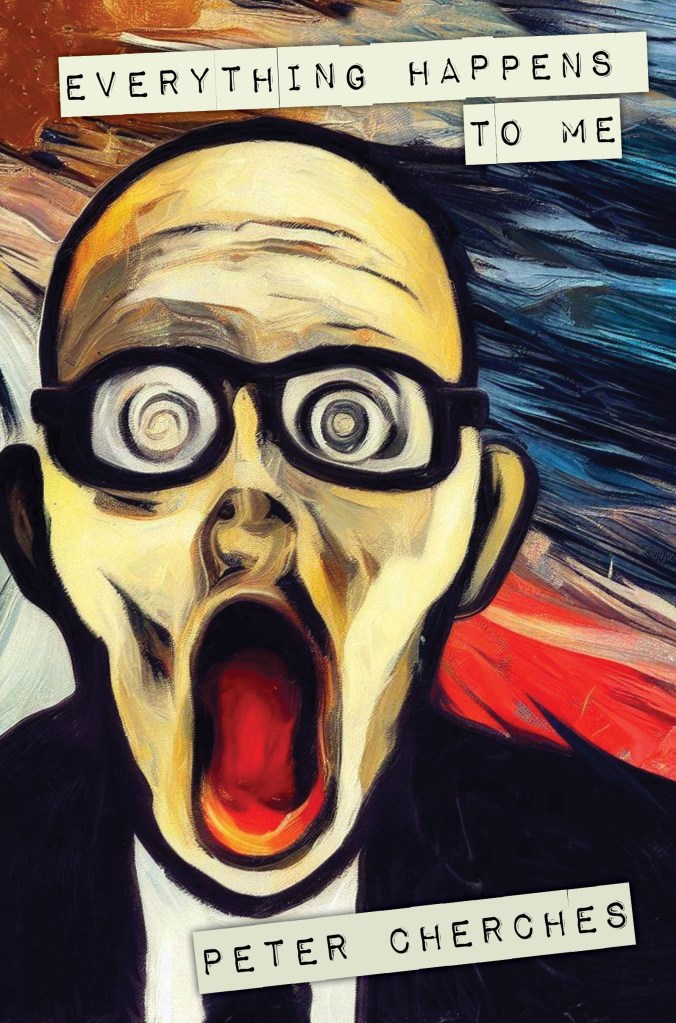
This month, novella-in-flash.com features an interview with the writer Peter Cherches, whose darkly absurdist novel-in-episodes Everything Happens to Me, which chronicles the bizarre yet everyday misadventures of a Brooklyn-based fiction writer, was published by Pelekinesis on 12th September.
Michael: Welcome to this blog, Peter, and congratulations on a remarkable new book. I’d like to start by asking you about one of the characters in it. At the centre of this novel composed of short-short stories is the figure of a first-person narrator, named Peter Cherches, apparently an alter-ego for the author (such are the uncanny similarities of his life – as writer and New York resident – to yours); the next most prominent character is the narrator’s unnamed neighbour in the apartment block where they are both residents.
Although the character of the narrator constitutes the foreground of the novel, it was actually the role of the neighbour – who pops up in so many of the chapters, in a variety of contexts – I became strangely fascinated by as I read through your book. I’d love to hear you talk more about this figure of the neighbour: what were the origins of writing about this character? What was it that interested you in the idea of the neighbour, and the particular dynamics of this narrator’s relationship with him?
Peter: The neighbour is actually based on my real-life next-door neighbour of 35 years. We do indeed have a strained relationship, and my portrayal of him is probably one of the most realistic aspects of the book. He plays the double role of antagonist and doppelgänger, so I wanted him to remain nameless, generic. Plus, it gives me plausible deniability. Many of the chapters are based on the protagonist-flâneur’s oddball encounters with a wide range of individuals, and the neighbour acts as a grounding constant.
The neighbour stories started out as a parallel project to the other work in the book and was originally intended as a separate volume. But after a while it became clear that the two groups were really of a piece, and the neighbour stories spread throughout the book acted as a kind of glue to give the overall project a narrative arc. The only other recurring character, Mrs. Papadopolous, is seemingly minor, but for me the few pieces in which she appears further shape the narrative, especially toward the end. Sequencing is always of utmost importance for my books, but in this case I hope it really does make a unified entity out of many individual pieces.
Michael: And how did you assess the sequencing? I’m imagining that it could have been especially challenging with a novel composed of 90 relatively miscellaneous short-short stories. A term I’ve previously used to understand this kind of novel-in-short-short-stories is the “novel-as-collection”, where there isn’t really a cause-and-effect kind of plot development (in which one incident leads into another), but instead what would otherwise be relatively standalone stories are given some kind of gentle tethering so they cohere – often through a recurring central character or two, and/or perhaps a common setting for the stories, and/or some recurring motifs for a more subtle “binding” effect (in the case of Everything Happens to Me, I might see the latter as things like the narrator’s occasional visits to restaurants/descriptions of food, references to jazz and popular song, encounters with childhood friends and old acquaintances, recurring doppelgängers, and so on). What was your guiding process for figuring out the order of these stories, when many of them might look – on the surface – like they could potentially appear in a different order if you’d wanted them to?
Peter: Sequencing any collection is a balancing act, but here, once I started considering the novelistic possibilities of this particular group of pieces, sequencing became of primary importance. While there is no traditional plot development, I wanted to nonetheless give a feel of forward motion. To that end, one of my sequencing strategies was a kind of poetic chronology; that is, while the pieces all take place in a generally sensed present, stories that harken back to childhood appear early in the book, and the end of the book brings intimations of mortality. Then there are the neighbour stories, which account for maybe 20% of the book. I wanted to spread those out at relatively equal intervals, with some earlier pieces introducing the character and the relationship, and later pieces building upon that relationship. The text is deliberately framed by two neighbour stories. As you’ve mentioned, there are also a number of other recurring themes and settings. In some cases there are several quite similar pieces that would come off as bafflingly repetitive if placed in close proximity, but, hopefully, carry a haunting resonance when peppered throughout the book–story doubles that echo the character doubles. In this book, as in much of my work, there’s a prevailing mood of anxiety and frustration, and I think those repetitions bolster that mood.
The sequencing and final edits were a simultaneous process. As many of the chapters were originally published as stand-alone stories, there were, for instance, duplicative setups and explanations that could be cut from some of the individual pieces.
Michael: About that “prevailing mood of anxiety and frustration” – in a number of stories in the book, the narrator enacts the role of a consumer – going into shops and restaurants, phoning up company helplines, and so on. The cumulative effect was that he seemed to me to represent a kind of frustrated or oppressed consumer in particular. Oppressed by contemporary capitalism, one might perhaps say, in its various manifestations? But in quite a comical way. A waiter denies that a pigeon has shat on the restaurant table. There’s a customer helpline for a utility company where the junior assistant says, in that apologetic yet oh-so-recognisably patronising way: “There is nobody with more authority.” The narrator orders a burger that’s branded the ‘Well-Beyond Impossible Burger’ and the burger doesn’t exist [second story at this link]. He calls the number in a Craigslist ad and it seems like a trap. And then there are many other ways in which the narrator seems absurdly persecuted by a malign universe: gross intrusions into his privacy, ransom notes, gossiping neighbours in the building where he lives, etc. Did you have a vivid sense, when you set out to write this book, of wanting the narrator’s “anxiety and frustration” to arise specifically – in an absurd and comical way – from the systems of modern life that surround him as a citizen-consumer, and that seem to confound and persecute him? And how does this chime (or not) with your own personal view of 21st century living?
Peter: It’s much more pedestrian than that. For me the physical marketplace is one of the richest sources of interpersonal interaction and offers a variety of settings. My own daily activities and lifelong neuroses animate the character who shares my name, and these days, since retiring from my day job, much of my time is spent walking around Brooklyn and taking a daily restaurant lunch, hence lots of restaurant stories and street encounters. [Photo credit: Elder Zamora]
Those familiar settings allow me to imagine and flesh out the encounters that start out seemingly normal and then take a surreal turn.
I think that “surreal turn” is the core of these stories, and it’s a mode I’ve developed over the years, beginning with a series of stories literally drawn from nightmares, in the 1980s, a rich source of frustration and anxiety. By taking those dream memories and forming them into coherent narratives, I developed strategies for keeping the disjointed, disturbing mood of dreams in a more logically constructed story. Eventually, I started creating my own nightmares. Incidentally, as an undergraduate I studied playwriting and dramatic literature, and was completely smitten with Strindberg’s A Dream Play.
I further developed this style in public, online. I joined Facebook in 2013, and I got the idea of posting odd first-person stories that at first appeared to be normal status updates. It was a perfect laboratory in which to develop my timing–how much normal do I give before things turn weird ? The comments told me when I was really suckering the reader in. Of course, when you pick up a book labelled “fiction” you’re not going to have that same experience, but the stories’ effects still are dependent on those same technical underpinnings.
While I’ve occasionally written politics-fueled pieces, usually in a satiric vein, there’s little that’s blatantly political in this book, except where the politics is at the core of the character’s anxieties, like his fear of a visit from the police.
As far as 21st-century capitalism is concerned, technology has reduced those commercial opportunities for being physically among the public, and I think that’s sad; I miss all those hours I used to spend poring through the bins at record stores. [Photo credit: Elder Zamora]
Michael: Those are really helpful insights into how fictional narratives can emerge from a writer’s unique process. You’ve been associated with “the short-short story” for many years, and are seen as one of the key figures behind the contemporary prevalence of it as a literary form. How do you feel about the mid-1990s emergence of the label “flash fiction”, which now seems to have taken hold as a primary descriptor for the form. Is it one that you readily identify with?
Peter: I suppose flash fiction is OK as shorthand, but I don’t love the term. I’ve always preferred “short prose,” which doesn’t make a fuzzy or arbitrary distinction between short-short story and prose poem, or even poetic essay. Most of what I see published as flash fiction tends to be shorter versions of the traditional short story, miniatures in the Chekhov through Carver lineage
I think a good number of us in the States who were doing short prose before the coinage of terms like sudden fiction and flash fiction–for specific anthologies, originally– came more out of a fabulist or surrealist tradition–the Kafka, Michaux, and Borges lineage–writers like Peter Wortsman, Lydia Davis, Russell Edson, Marvin Cohen, and Barry Yourgrau, for instance. [Photo credit: Scott Friedlander]
Michael: That’s a really interesting observation about two lineages and traditions. Here’s a final question: I’ve always observed via your social media posts that you have eclectic reading tastes in the field of “short prose”. Could you leave readers of this blog with a list of recommended books they could explore, within the broad category of the “novel (or novella) in short episodes”, or novel-in-flash, or novel-in-short-short-prose, however it might be defined?
Peter: I love to evangelise about books, especially neglected ones. I’ll start with a cluster of titles that were extremely influential on me–Henri Michaux’s A Certain Plume and several works that run with Michaux’s premise, the adventures and observations of a somewhat cartoonish everyman who views the world with an idiosyncratic eye. Julio Cortázar’s A Certain Lucas is clearly an homage to Plume, and Calvino’s Mr. Palomarshares the approach. My own prose sequences inspired by these, “A Certain Clarence” and “Mr. Deadman,” both appear in my collection Lift Your Right Arm. But for Calvino my strongest recommendation is Invisible Cities, and for Cortázar Cronopios and Famas.
Nathalie Sarraute’s Tropisms is often cited as the opening salvo of the Nouveau Roman movement. One might call it an anti-novel or one might call it a collection of prose poems. It’s certainly anti-character; if I remember correctly there are no proper nouns. Rather than plot or character, what makes the whole greater than the sum of its parts are what the author calls “inner movements,” which “slip through us on the frontiers of consciousness in the form of undefinable, extremely rapid sensations.” Written in a spare yet poetic style that concretizes her abstractions, it’s a remarkable work, especially considering it was composed in the 1930s. I may have been unconsciously inspired by Tropisms when, in 1980, I wrote my first minimalist prose sequence, “Bagatelles,” where the two characters–named I and she–are virtual stick figures with attitude.
This might be a surprising choice, but Sinclair Lewis’ Babbittdiffers from his other novels by building up a narrative largely from set pieces of varying length, an approach shared by another favourite writer, Evan S. Connell in Mrs. Bridge and Mr. Bridge.
I’ll close with two remarkable minimalists. Kenneth Gangemi’s best known book is the “novel” (I think it’s only 60 or so pages) Olt, but his The Volcanoes from Pueblais a travel narrative of a motorcycle trip through Mexico told in a bunch of short sections on various topics, presented alphabetically, like an encyclopaedia. Also brilliant is his novel The Interceptor Pilot, which takes the form of a film script.
Toby MacLennan has only published three small books of prose over a six-decade career; she works primarily as a multimedia artist. Her 1 Walked Out of 2 and Forgot It, published in 1972 by Dick Higgins’ legendary fluxus-adjacent Something Else Press, is wonderful, mysterious, and sui generis. I don’t know how else to describe it except that it’s perhaps a literary equivalent of Magritte’s paintings. The individual pieces range from one sentence to a half page. There’s plenty of blank space. She calls it a novel. Unfortunately, it’s long out of print and difficult to find. But her excellent 1996 collection Singing the Stars is still in print from Coach House Books.
Peter Cherches Biography – Called “one of the innovators of the short short story” by Publishers Weekly, Peter Cherches has published five full-length fiction collections as well as a number of chapbooks and several nonfiction books. Since 1977, his work has appeared in scores of magazines, anthologies and websites, including Harper’s, Fence, Bomb, Semiotext(e), North American Review, Fiction International, and Billy Collins’ Poetry 180 project. He’s also a jazz singer and lyricist. For more information on Peter, you can access his Facebook Author Page here.
==================================
Don’t want to miss this blogpost series? Sign up to receive each new post direct to your email in-box (and get access to exclusive offers on mentoring) here:
Join 266 other subscribers
Are you working on a novella-in-flash? Or wanting to write one? Find out more about Michael Loveday’s Novella-in-Flash mentoring: here.
I love the clarity and directness of this story’s narration. To take an obvious example, how about the simplicity of the arrival of the stranger? It takes a certain kind of writerly boldness to use a separate paragraph of only two plain words: “He approaches.” Another writer might have worried that this wasn’t enough, that the reader needed to be told how he approaches. Yet adding a fussy clarification could dilute the impact of the dramatic action – the approach itself is the thing, and in the starkness of those two words there’s a hint of an encroaching. Let’s call this Shift #1.
Elsewhere, in the set-up of the story, Brown makes skillful and judicious use of descriptive background detail: just enough is sketched, in order to conjure pictures for the reader and give a sense of atmosphere, without anything being over-egged:
“Across the street is a car dealership, used cars for sale, rows of American flags flying high above, but otherwise, no one else but us and the freeway, buzzing in the background.”
How discretely that description politicises the story! In another deft paragraph of description soon afterwards, I’m reminded of Shira Erlichman’s mantra for writers “Sensuality > Concepts”:
“The guy’s carrying a huge garbage bag, wearing army fatigues, cuffs fraying at the bottom, cap pulled tight over his forehead, a stained red vest over a dingy long-sleeved shirt.”
We don’t need to be told more about this stranger to understand.
Then notice how a sudden moment of error (a conversational misstep after a question) is allowed by the story to resonate fully, like a swear word audible at a dinner party that has suddenly gone silent: “And as soon as I’ve said it, I feel a little stupid. A little small… There is a pause. Nothing between us but the sound of the rush-hour traffic.”
Let’s say the question + the misstep of the response which immediately follows = Shift #2. The writer here trusts enough in the dramatic energy of her material that she can self-consciously slow down the story and linger upon this new moment.
The questioner responds slightly threateningly (“[moving] his hands wildly around his face… an imitation of someone’s worst nightmare street-version of the boogeyman”), which might be considered Shift #3. Then, with a light touch, Tami Mohamed Brown moves the story naturally into a Carveresque moment: the questioner yearns for a self-awareness that’s a kind of self-doubling (Shift #4):
“If I could get outside myself—if I could stand outside myself and look in for just a little bit—what would I see?… Would I see a crazy riffraff guy, a bum? Would I see something terrible?”
(The reader’s interest, now, has been balanced equally between the narrator and the stranger. The story has shown both figures wrestling with their consciousness, self-doubting: firstly in the ripples within the narrator’s 1st person POV reflections, and secondly we’ve been shown the other character’s existential uncertainty through his dialogue.)
And I love how, having explored various ideas of awkwardness and profundity, the story changes gears yet again (Shift #5) before it ends – slipping into a mood of casual lightness and joy:
“He tosses the orange back and forth, from one hand to the other, as if he were juggling more, under the streetlight. I applaud. He stops and bows, hands together in a Namaste, bending deeply from the waist. He straightens.”
And finally, at the resonant close, there’s that exquisite final moment of ambiguous and unresolved epiphany (Shift #6), which I’ll leave you to discover and enjoy.
So many lovely little transitions in this scene of less than 750 words! Truly a marvel of balance and concision, a wondrous small gem of writing craft.
How might you weave subtle and multiple transitions like these into your writing? Might you introduce a change of mood before the end – joyful to poignant/bittersweet or vice versa? Or introduce moments of self-reflection/self-scrutiny? Might a character misjudge something or do something unwise? Might there be a transcendent epiphany – a discovery of sorts? Might you shift the spotlight, through dialogue, from one character’s struggle to another’s (without changing the POV)?
Here are some prompts you might use to get going, following Tami Mohamed Brown’s story:
William James, brother of novelist Henry James and diarist Alice James, was a leading 19th century philosopher and one of the founders of modern psychology.
In his book The Principles of Psychology(1890), a publication that is often credited with making the idea of “stream of consciousness” more widely known in Western culture, one of the things he does (in Chapter 10) is name and describe three distinct aspects of human experience: the material self, the social self, and the spiritual self.
Story writers can have fun exploring fictional characters via the triple lens of these categories, and using them to uncover new insights:
(a) The material Self, for example…
the body
clothes
possessions
home
family (as we share common genes)
things we have made
Invitation: When you consider the material aspects of your main characters’ lives (as listed above), what specific details of their experience might you newly identify and describe? Feel free to indulge all five senses, where relevant, as you write, and include sensory details. Try writing a good page or two (or three!) of notes that you might use as texture informing (explicitly or implicitly) the stories/chapters themselves later on.
Notice how Hills describes the narrator discovering new things about the character, through the objects she encounters in his room. The narrator feels she ought to have known these things already, and her sense of the other person is therefore destabilised. Notice too, how before the microfiction reaches its end-point, the narrator starts envisioning the other person within the context of the objects in the room, and then how the real-world situation suddenly changes for the narrator, in a surprising shift of the action. Also note how the key physical object of the mixtape in the story is naturally imbued with an emotion that has parallel relevance for the wider story context, as a mixtape is associated with nostalgia, obsolescence (of a technological kind), and relationship (since mixtapes are often given as gifts), and sothe emotions inherent in the object have resonance for the overall themes of a story about loss.
Invitation: Pick one of the following writing prompts and create a new scene/story, or (if you prefer) try sketching out some “notes-towards-a-story”:
Today’s blogpost develops the recent theme of going further with the settings you use in your writing. We’ll approach the topic from a fresh angle by exploring the work of the Anglo-Irish poet Michael Longley, to see what can be learned from him more generally for writing about physical environments of all kinds. (NB See here and herefor two other recent blogposts about making the most of settings in your writing).
For those who don’t know Longley’s writing – a brief intro…
Longley was born in Belfast in 1939 and worked in Belfast, Dublin, and London before retirement. Along with Seamus Heaney, Derek Mahon and others, he has been celebrated as part of the remarkable cohort of Irish writers revitalising poetry from the 1960s onwards. Although all of his books contain outstanding poems, his collections during the period from Gorse Fires (1991), through The Ghost Orchid (1995), to The Weather in Japan (2000) are – for this reader at least – particularly worth seeking out, as they contain perhaps his most consistently brilliant work. He is known for his poems responding to The Troubles, for his translations of Homer and other classical poets (often speaking obliquely, as in this example, about modern conflict through ancient texts), and for writing about the First World War (in which his father fought), but if there is one subject he has returned to even more frequently than all of these, it is the physical landscape of Carrigskeewaun, in County Mayo in the West of Ireland, where Longley – throughout his life – has made regular visits to stay in a remote cottage belonging to a friend.
Michael Longley, Collected Poems (London: Jonathan Cape, 2007)
Over the years of reading Longley’s poetry, I’ve returned to his poems about Carrigskeewaun repeatedly, wondering what it is that beguiles me on the page and keeps me reading. What is it that elevates these poems beyond the routine tropes of pastoral poetry?
In what follows, I’m aiming to uncover some strategies we might apply to writing about landscapes and locations of all kinds, including the urban…
Invitation #1: As writers, whether we are most drawn to write about rural or urban settings, we could be inspired by Longley’s example to become fascinated by a particular kind of territory, and to root our writing somewhere recurringly (even if, as with Longley, it’s not where we live). What might happen in our writing if we explore a particular type of physical situation especially deeply? What might that specific location be in your case? Or maybe instead it’s a type of location you’re fascinated by – ports, airports, churches, mosques, rivers, bridges, hospitals, nightclubs, schools, factories, farms, solar farms, and so on. How might you develop what might be called a “productive obsession” in your writing?
(2) Another part of the answer, for me, is that Longley scrutinises landscapes with the triple-eye of a botanist, ornithologist, and zoologist all rolled into one. In his poems he is a model of good practice for “the writer as witness”, a mindset and responsibility that transcends subject matter, genre or literary form. Such a detailed witnessing and understanding of landscape, including a deep knowledge of its associated shapes and vocabulary, is not a skill we are born with – it’s something acquired through diligent study and a lifetime of accumulation. Longley, for example, gained much of his knowledge of botany via a 40-year friendship with the painter of orchids Raymond Piper.
Invitation #2: How might we as writers become more devoted to learning about the physical world we inhabit? If you’re interested in urban spaces, might you research cities as a physical phenomenon? Or the architecture of individual buildings? If you’re interested in rural places, how might you be inspired to strengthen your knowledge of natural forms? In short, how might we all delve even more deeply into the phenomena of the physical world, as Longley has?
(3) Furthermore, Longley is particularly good at manifesting competing impulses within his depictions of landscape: abundance and entropy, tenderness and brutality. Time and time again, his descriptions of settings contain shades of nuance, doubleness and complexity.
And here, in ‘Between Hovers’, what could be purely a bleak narrative about a dead badger and a dead otter is suspended within a balanced framework that is “floodlit… [with] filament[s] of light… [and] sparkle…”, includes reference to “a spring tide”, and moves towards a closing image suggestive of transcendence.
Invitation #3: Where might you find opportunities, in your own writing, to remain open to complexity, by finding in your landscapes/locations contrasting aspects of both vitality and decay? Or a fluidity between gentleness and harshness?
(4) Lastly, Longley often places human experience within the context of the natural, or frames the natural world within the context of the human. He does this by effortlessly setting human and natural objects side by side within his landscapes, or else by deploying particular verbs or nouns as metaphors to make the natural and the human seem even more deeply intertwined.
Here, in ‘The Strand’ (part of the ‘Carrigskeewaun’ sequence again), the trails of a bird, children, and the narrator are all shown to be physically interconnected with and adjacent to the sand dunes and the seashore:
”….a sanderling’s tiny trail, The footprints of the children and my own Linking the dunes to the water’s edge…”
And here, in ‘The Leveret‘, we can see Longley toying with individual word choices to mix up ideas of the human (or human-built) and the natural: the conception of a baby is a “fire-seed”, young birds are a “sootfall”, and the leveret takes “breakfast”, an image that seems, in this context, very humanised.
Invitation #4: In your own writing, might you experiment with juxtaposing/blurring the natural and the human, through your choices of objects, symbols and metaphors? Might you, for example, experiment with using verbs that humanise your physical settings, or make your descriptions of people seem more animal-like, in an artful way?
One Final Invitation: In the coming days, why not carve out a bit more time to linger with Longley’s poems (there are some further links below…) and then return to your novella-in-flash (or any other writing project – a short story, a set of poems, a novel), and explore ways to transform your writing. In what new and subtle ways might it become a treasure house of encounters with the physical world that surrounds us…
Don’t want to miss this blogpost series? Sign up to receive each new post direct to your email in-box (and get access to exclusive offers on mentoring) here:
Join 266 other subscribers
Are you working on a novella-in-flash? Or wanting to write one? Find out more about Michael Loveday’s Novella-in-Flash mentoring: here.
Recently I’ve been considering this principle more than ever before: the action of writing about place is always political. This truth perhaps feels like it has even greater and more tragic resonance in our current era, where landscapes are territories strongly contested by multiple forces, yet it has manifested in so many different ways throughout centuries of world literature.
Some writers already have an inherently politicised relationship with landscape because of their personal connection to a particular location – whether as a birthplace, or as “home turf”, somewhere that a person has rooted, or somewhere our ancestors were rooted.
Not all writers feel they have a readily personal link to physical landscapes that contain deeper, political resonances. Depending on where we live or have lived, we might feel like the physical settings we’re most connected to are too ordinary.
It’s a surprising truth that what feels like ordinary territory to one person can be astonishing or revelatory to an outsider who isn’t familiar with that place. Our ordinary can be someone else’s extraordinary, because sometimes we overlook what’s notable about the everyday world that surrounds us. Sometimes, too, our families or communities connect us to landscapes in deeper, more entangled ways than we conceptualise when we’re simply going about our daily life.
And ultimately every landscape, whether rural or urban, is inscribed with both a natural and a human history that is fundamentally political – not just the history of animal and plant life that has flourished or waned there, but also the history of our human relationship with that land, and how we have interacted with it over time (through agricultural machinery, or buildings, patterns of mapping, or physical sculpting and reshaping, or sometimes merely in the act of walking through it). Landscape in this way becomes more than only a physical territory: it contains layers of history, politics (local, national, or international), and story.
Invitation #1: Here are some questions to get you exploring your own personal connection to landscape and place. I invite you to find a spare 30-40 minutes or so (this weekend or at another time), and write out some reflections in response. And then whatever themes emerge, be open to the possibility of new ideas percolating their way into your current writing projects:
In what kinds of environments have you lived and worked? (In other words, the places where you have rooted, to a greater or lesser extent.)
To what kinds of environments have you travelled?
Do you consider yourself a rural or urban person, in your upbringing?
Which type of environment – rural or urban – has the stronger or more positive associations for you now, and why?
To what extent do you consider yourself rooted (or rootless)?
What are the racial, ethnic or national identities that have shaped your experience of place, and in what ways?
How have broader environmental issues (climate, food, wildlife, housing etc) affected your life, or the lives of people you know personally?
How would you describe your relationship to the planet as a whole?
What are the key incidents and influences from your life through which place or environment have had an impact upon your identity?
TIP: As well as containing story, a landscape will also inevitably carry layers of emotion. As Graham Mort has written, in his brilliant essay ‘Landscapes and Language’: “A landscape poem or descriptive prose passage is always more than pure description… Landscapes in this respect are psyche-scapes, metaphors representing the yearnings and aspirations, hope, betrayal, anger and bitterness that we see in them.” (from The Creative Writing Coursebook, Julia Bell & Paul Magrs (eds.), (London: Macmillan, 2001), p.180). So as you start making notes about landscapes you’re personally connected to, notice any feelings associated with them, as well as simply trying to witness their physical existence. (If you notice challenging feelings arising, you have the freedom to decide to keep writing through the feeling until it transforms or subsides, or otherwise pause and distract yourself with another activity, chat to someone, or go for a stroll / get your body moving.)
Invitation #2: As a second activity this weekend (or at a more convenient time for you), I invite you to go out into your local landscape with a notebook or smartphone and practise the following two-part exercise as an act of witnessing: (a) observing the physical reality of things closely, and (b) finding vivid and specific language for capturing/evoking those physical things on the page. Consider the following categories of noticing, if they’re helpful:
(1) details of nature (incl. any interaction between “natural” and “human”) (2) architecture (incl. decorative vs. functional vs. culturally symbolic or meaningful; and manifestations of the passage of time within architecture) (3) people – as individuals and people in groups (e.g. why this person with these people as a group? clothes as a statement/unconscious signal; what is the person carrying and why? what are the person’s emotions? what kind of activity are they participating in?) (4) technology/equipment (its purpose, what materials is the technology using, how it might have been made, and by whom, and what effect does it have on its surroundings?)
Again, afterwards, be open to some of this observed material finding its way into your current writing projects…
Above all, have fun exploring the landscapes and locations you personally know. Consider them as if you were seeing the territory for the first time…
==================================
Don’t want to miss this blogpost series? Sign up to receive each new post direct to your email in-box (and get access to exclusive offers on mentoring) here:
Join 266 other subscribers
Are you working on a novella-in-flash? Or wanting to write one? Find out more about Michael Loveday’s Novella-in-Flash mentoring: here.
Vivid locations, deftly sketched, are part of the contract we establish with readers that our story is authentic. Especially in long-form fiction, they are one of the subtle supports for persuading the reader to suspend disbelief and immerse themselves in the story.
In one-off flash fictions, passages of description may sometimes be minimised, due to the compressed nature of that individual form. But in a novella-in-flash, your settings and locations can have a more meaningful role in building story and atmosphere, through the gradual accumulation of detail across chapters. Plotting out your settings and locations on a map can also be a fun way to bring to life the novella you are imagining.
It can be helpful to think about your settings as if they were characters or entities in their own right. What’s more, a piece of description is always more than just description. It reflects the emotions and inner world of the protagonist or observer. The way human participants relate to their physical environment contains dynamic narrative potential.
Vivid, specific and unusual details can make scenes feel alive. Flash fiction writer and editor Randall Brown refers to Charles Baxter’s concept of ‘defamiliarization’, encouraging writers to focus on what’s unfamiliar and atypical about a location, the aspects of a scene that seem idiosyncratic, rather than giving the reader predictable and predetermined details. (Randall Brown, Pocket Guide to Flash Fiction (Wynnewood: Matter Press, 2012), pp.128–136)
Invitation: Pick one of the following prompts and write a new scene/story for your novella, or (if you prefer!) try sketching out some “notes-towards-a-story”, perhaps via the creative mind-mapping technique that Liz Berry talks about in this article.
Take a character to a location/landscape that’s physically or emotionally dangerous or risky. How do they respond?
Show a character in a landscape that’s full of vitality/abundance or ruin/decay. How do they respond emotionally? How are they prompted to interact with it/act?
Write a story where a character crosses or fails to cross a boundary of some kind (to go somewhere off-limits, forbidden or hidden)
Show a character settling down or choosing to settle down somewhere and treating this place as “home”. What emotions do they feel?
Show a character escaping/trying to escape/wanting to escape. What are they needing to escape? How are they feeling? Are they successful?
Show a character returning to somewhere that’s very familiar to them, after a long time away. What emotions do they feel?
Show a character arriving somewhere that’s completely new and unfamiliar to them. What emotions do they feel?
If your character(s) live(s) in a city, take them to thecountryside (orvice versa). How do they feel in that new environment? How does it make them behave?
OPTIONAL: Consider using vivid, specific and unusual detail to bring to life the spirit of the location itself, and explore a character’s reaction to (or interaction with) the location. By the end of the flash, does the character realise something (about their environment, or a relationship or their status in/connection to the world)?
Don’t want to miss this blogpost series? Sign up to receive each new post direct to your email in-box (and get access to exclusive offers on mentoring) here:
Join 266 other subscribers
Are you working on a novella-in-flash? Or wanting to write one? Find out more about Michael Loveday’s Novella-in-Flash mentoring: here.
Think about which aspects of character a pressurised/unfamiliar situation might uncover: (a) What flaws of theirs might be exposed? (b) Or in what ways might they thrive unexpectedly? (c) And what might then follow on from EITHER (a) OR (b), for the ongoing story?
Here are some methods for stretching your characters beyond their comfort zones:
Your character crosses a physical boundary of some kind (to go somewhere off-limits, forbidden or hidden) OR
A scene with a long-standing friend or a cherished relative is unsettled by a disagreement or conflict. Who loses their cool or gets rattled? What unexpected things are said?
Photo by Stewart MacLean on Unsplash
OR
Your main character meets a stranger. What’s the mood – awkward? tense? confusing? surprising? What unexpected or disconcerting things does the character notice about the stranger? What words, if any, are spoken by them? OR
An encounter with a wild animal – an encounter that unsettles them or alters them in some small way (NB the animal could be a pet, if that pet might unsettle/alter them somehow, or else a wilder creature) OR
Your character breaks a previously established rule (this could mean transgressing a social convention/code, or officially breaking the law) OR
Your character comes into conflict with institutional power in some form (you might think in terms of government, judiciary, healthcare, educational, corporate, and so on) OR
Write about a character and a taboo/fetish/obsession OR
A character having a supernatural encounter or unsettling spiritual experience OR
Your protagonist meets a person / couple / social group that’s verydifferent in some fundamental way from themselves. How does your character interact / react? Perhaps something awkward, tense, confusing or surprising happens? OR
Challenge your character(s) with a task, problem or role that’s beyond their current capabilities or natural skillset. What’s their unique response to this unique problem? OR
Throw your character(s) into an unfamiliar environment – perhaps one that feels incongruous for their core identity. (The classic “fish out of water” concept so beloved by Hollywood scriptwriters…) OR
An encounter with an enemy, rival or “frenemy”. Will it involve out-and-out conflict? Or will it be merely a banal encounter? Embarrassing? Awkward? Establish a mood that suits your overall story.
Invitation: Pick one of the above prompts and write a new scene/story for your novella, or (if you prefer!) try sketching out some “notes-towards-a-story”.
OPTIONAL EXTRA: Pick more than one prompt from the above list, and put your character(s) under pressure several times across multiple scenes!
OPTIONAL EXTRA: When describing performance under pressure, people sometimes distinguish between “comfort zone”, “stretch zone”, and “panic zone”. Do the implications of these categories have any bearing on the situation for your character? Or are there other relevant names you would use for “zones” you would push your character into?
OPTIONAL EXTRA: Ernest Hemingway, in an interview with Dorothy Parker for the New Yorker, once defined courage as “grace under pressure.” What one main quality does your character exhibit when under pressure here? Might it be something completely different from Hemingway’s concept of “grace under pressure”?
Don’t want to miss this blogpost series? Sign up to receive each new post direct to your email in-box (and get access to exclusive offers on mentoring) here:
Join 266 other subscribers
Are you working on a novella-in-flash? Or wanting to write one? Find out more about Michael Loveday’s Novella-in-Flash mentoring: here.















 The Novella-in-Flash